
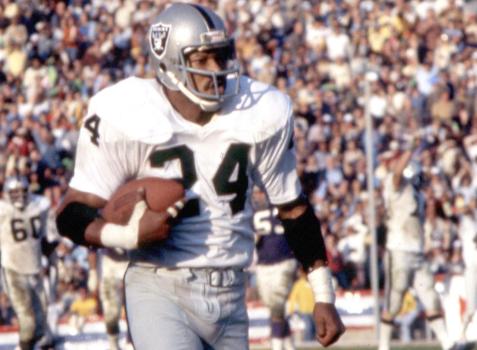
Willie Brown
Sport: Football
Induction Year: 1985
University: Grambling
Induction Year: 1985
Willie Brown intercepted 54 passes in his 16-year National Football League career, but he is best remembered for one that isn’t included in that total.
On Jan. 9, 1977, Brown’s Oakland Raiders were playing the Minnesota Vikings in Super Bowl XI. Both teams had been there before, and had come away empty-handed. A record crowd of more than 100,000 spectators poured into Pasadena ‘s Rose Bowl to watch one of them change its image.
The game was a blowout, but the Vikings had a ghost of the chance early in the fourth quarter when Fran Tarkenton threw a pass intended for Sammie White in the left flat.
Brown cut in front of White, took the pass in his mid-section and romped 75 yards for a touchdown that removed all doubt. Along the way, he set Super Bowl records for yardage for one interception, on game and one career.
Two years before that game, Brown returned to his alma mater—Grambling State University—to speak at a banquet. He met White, then a junior, and offered a bit of encouragement regarding his prospects for a professional career.
“You might be playing against me one of these days,” said Brown, who was president of Grambling’s senior class of 1963.
From the day Brown arrived at Grambling, coach Eddie Robinson knew the kid from Yazoo City , Miss. , was something special.
“From the very beginning,” Robinson recalled, “Willie was a clean-cut athlete, very fast. He was one of the guys with great ability. It wasn’t real important where we put him. He would’ve been a great running back, or great tight end, because he was such an outstanding blocker. And he had character.”
Brown, who played tight end and linebacker at Grambling, credited Robinson with developing him into a pro prospect. He even had fond memories of the 5a.m. workouts, when the legendary Grambling coach threatened to throw sand in his face.
“The thing about Coach Eddie,” he recalled, “was the way he’d make you go to classes, go to the library after school, go to church. Oh, did he have sharp eyes. Like going to church. We wanted to make sure he saw us. Otherwise, he’d ask us on Monday where we were. We’d try to walk in front of him for a minute. We thought that would get us of the hook.”
Professional talent scouts’ eyes weren’t as sharp as Robinson’s. After Brown’s senior season, nobody was interested. Grambling defensive teammates Buck Buchanan, Lane Howell and Leon Simmons got all the attention. But Robinson finally convinced Pop Ivy of the Houston Oilers to take Brown as a free agent.
“The first day,” Brown recalled, “Ivy handed me a playbook and told me I was a defensive back. He also told me to slim down.” Brown, whose playing weight at Grambling ranged from 220 to 225 pounds, slimed down just in time to be traded to the Denver Broncos. After four years in Denver , he was traded to the Raiders.
Sammie White was in the fourth grade when Brown—then playing for the Broncos—tied a pro record with four interceptions in one game against the New York Jets. He had nine interceptions that year and 15 in four seasons with the Broncos. Then Brown and former Louisiana Tech quarterback Mickey Slaughter were traded to the Raiders. Brown went to Oakland , intercepted 39 more passes (a club record) and played in five AFL All-Star games and four NFL Pro Bowls. Slaughter went back to Ruston to join a coaching staff Maxie Lambright was putting together at Louisiana Tech.
Brown became the Raider’s defensive captain, and won the 1969 Gorman Award as “the player who best exemplifies the pride and spirit of the Oakland Raiders.” Three years later, he was honored for his work in the NFL drug abuse campaign. By the end of his career, he ranked second among active players in career interceptions despite the fact that quarterbacks were reluctant to throw in his direction.
The Raiders’ 1976 press guide proclaimed Coach John Madden’s team as “the Good Guys”—responding to the outlaw image earned by players such as defensive backs Jack “They Call Me Assassin” Tatum and George Atkinson. But nobody ever accused Willie Brown of being anything except a class act—and on of the greatest defensive backs who ever played the game.
He played two more seasons after Super Bowl XI, and became the first player in NFL history to intercept at least one pas in 16 consecutive seasons.

Recent posts
-
Louisiana Sports Hall of Fame announces star-studded 2027 induction class September 9, 2026

-
Hall of Famer Jerry Stovall passes away at age 85 August 31, 2026

-
Passing of a legend: LSU’s transformational Skip Bertman dies at 88 August 14, 2026


