
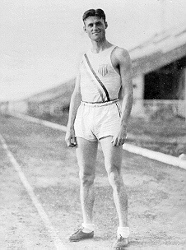
Sidney Bowman
Sport: Track and Field
Induction Year: 1976
University: LSU
Induction Year: 1976
Although no officials knew it at the time, and very few people ever found out, Sidney Bowman was the Jim Thorpe of the 1932 Los Angeles Olympics.
He didn’t win the decathlon. He didn’t even win a medal. But Bowman, like Thorpe in the 1912 Stockholm Olympics, was a professional athlete who was competing against amateurs.
Thorpe lost his medals (which were finally restored nearly 30 years after his death) and records because he had played semi-pro baseball for $25 a week. Bowman got a better deal than that from the St. Louis Cardinals in an Oxford, Miss. restaurant in 1931. They offered him $3,500, and he took it.
He played two weeks with the Cards’ Sioux City, Iowa farm club in the summer between his junior and senior years at LSU, batting .415 and hitting a pair of home runs. The deal called for him to play for the experience that summer, then negotiate a proper contract with the Cardinals after he finished at LSU. But Judge Kennesaw Mountain Landis, the baseball commissioner, threw a monkey wrench into those plans when he declared all underclassmen off-limits to major league clubs.
Bowman came home to play semi-pro ball, as he had done for several years. They only person who knew what had transpired was a Hammond buddy, Vic Anderson. But Bowman kept the money, giving $2,500 to his father to deposit in a savings account.
“He though I had robbed a bank,” Bowman recalled with a chuckle.
When he told the story 25 years later, Bowman wasn’t worried about the consequences. “It doesn’t matter,” he said “I don’t have anything for them to take away.”
Bowman and Anderson were Hammond High’s first All-State football players. They also played basketball and baseball. But track and field was the sport that eventually put Bowman in the Louisiana Sports Hall of Fame.
In the summer following his high school graduation, a Hammond classmate submitted his name for the Southern AAU Olympic Tryouts in New Orleans. He won three events, qualifying for the Regional Olympic Trials in Dallas.
Foster Commagere, then coaching at St. Stanislaus College in Bay St. Louis, Miss., took the Hammond youngster to New Orleans for workouts at Loyola. Commagere also bought him his first pair of jumping shoes.
Bowman jumped 48-2 ½ in the hop, step and jump (now called the triple jump) at Dallas, but didn’t equal the national interscholastic record of 49-1 he set earlier in the year. Baker’s Billy Brown broke that record a few years later, setting a record that stood for 26 years.
The next step was the national AAU championships at Harvard University, where Bowman’s 48-5 jump was a second to two-time champion Levi Casey. That gave Bowman a berth on the United States team in the 1928 Amsterdam Olympics.
Bowman competed in both the 1928 Amsterdam Games and the 1932 Los Angeles Games, but didn’t win a medal in either. Japanese athletes were gold medalists both years.
He was the 1932 national AAU champion at Palo Alto, Calif. with a margin of one inch over another Louisiana athlete, Rolland Romero of Loyola.
At LSU, Bowman set school records in the long jump with 23—1 and the hop, step and jump with 49-7 1/2. As a senior, he won the hop, step and jump in the Penn Relays.
His athletic success was the result of hard work. “I would be practicing when the other boys were doing something else,” he recalled a half-century later. “I used to come home in the evening and have to crawl up the stairs on my hands and knees to get to the bedroom because I was so exhausted.”
Nicknamed “Snaky” because of his running style in football, Bowman also excelled in that sport at LSU. He gained 193 yards from scrimmage in the Tigers’ 27-14 homecoming victory over Sewanee in 1929.
Bowman endeared himself to the Tigers’ No. 1 fan, Governor Huey Long, with a spectacular performance in LSU’s 27-12 victory over Arkansas at Shreveport in 1930. That started an unbeaten streak against the Razorbacks that was still intact when Arkansas moved into the Southeastern Conference more than 60 years later.
Long, a former Shreveport resident who was rejected by Caddo Parish when hw was elected governor in 1928, was anxious for “his” team to make a good showing in the city he loved to hate. He gave the Tigers a pep talk before the game, telling them they should win because Louisiana had better roads than Arkansas .
Later, Long invited Bowman several other LSU football players to live with him in the governor’s mansion.
“I want y’all to live with me in the mansion,” the governor told them. “You’ll get a lot better grub at my place.”
Bowman though the move might cause bad blood on the team, but the other players paid little attention to Long’s antics.
The main reason was the governor’s thirst for knowledge about football. He continuously pumped his guest for explanations of the game’s finer points. On one occasion, he had 11 chairs brought into the ballroom and asked his guests to demonstrate the Tigers’ various formations.
The players ate with the Longs at every meal, with the governor insisting that they drink sour milk because he didn’t think sweet milk was good for them. They had plenty of steaks, turnip greens, cornbread and pineapple upside down cakes. Ed Khoury, LSU captain in 1932, weighed 240 pounds when he moved into the mansion and 300 when left.
After Bowman’s senior season and the 1932 Olympics, the real world didn’t exactly welcome the former star with open arms. The nation was mired in the Great Depression. Bowman worked for the State Department of Revenue, checking beverage stamps on liquor bottles at places ranging from posh country clubs to skid row dives. “That was the best education I ever had,” he recalled later.
Bowman died on April 28, 1986.

Recent posts
-
Kathy Holloway earns ’26 Dave Dixon Louisiana Sports Leadership Award January 8, 2026

-
Gil LeBreton, John James Marshall are 2026 sports journalism inductees in LSHOF January 7, 2026

-
Third year of impactful LSHOF membership drive launches November 4, 2025


