
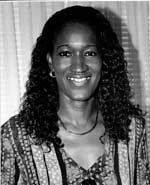
Queen Brumfield Nard
Sport: Basketball
Induction Year: 2002
University: Southeastern
Induction Year: 2002
Brumfield is the greatest player in the history of Southeastern Louisiana University women’s basketball. The only three-time All-American in the history of Lady Lions’ basketball, Queen Brumfield set career marks in points (2,972) and rebounds (1,586) which have remained untouchable. The rebounding total is a state record. Brumfield, a three-time All-Louisiana player, led the Lady Lions to the 1977 AIAW National Championship as well as four consecutive LAIAW state and SWAIAW regional championships. Along with her career points and rebounds marks, Brumfield also holds numerous other SLU standards.
By Robin Fambrough
The first time a high school coach asked Queen Brumfield Nard to play basketball, she didn’t hesitate. She just said no.
When the same coach, Ann Smith, wanted to ask Nard’s mother if the 16-year-old could join the Kentwood High girls basketball team, she wasn’t worried.
Nard was convinced her mother would say no.
Basketball legends don’t start like that. Nard proved she was an exception to this rule and several others by becoming a three-time All-America selection for Southeastern Louisiana University in the late 1970s.
Ask Nard for her thoughts on being elected to the Louisiana Sports Hall of Fame, and you’ll get a typically humble and soft- spoken response.
“I’m very flattered,” Nard said. “To have people recognize what you done, especially when time has passed by, means a lot.
“But you know, I never really thought of myself as a great player. Because I started playing basketball late, it seemed like I was always working to catch up with everyone else. The other players around me – they were the people I looked up to. “The records show something different, I know. But I always thought the other players were the stars. I was just out there doing whatever the coach told me to do.”
In reality, plenty of players and coaches did look up to Nard because of the incredible things she did as a post player for SLU from 1975-79. Nard is the school’s all-time scoring leader with 2,972 points and top rebounder with 1,586. Those numbers amount to career averages of 22.3 points and 11.9 rebounds per game that also lead the Hammond school’s all-time list. In addition, Nard holds the single-season records for points (910), scoring average (26.0), rebounds (431), field goals (351) and free throws attempted and made (284-208).
In 1977, Nard helped lead SLU to the Association for Intercollegiate Athletics for Women’s Division II Small College National Championship.
Those who followed women’s basketball in the 1970s have a decidedly different point of view. They say Nard, now a mother of five and a self-employed businesswoman in the New Orleans area, was truly one of the all-time great players in Louisiana history.
However, because Nard played in an era in which television and media exposure for women’s basketball was limited, few people outside of Tangipahoa Parish knew of her accomplishments.
LSU coach Sue Gunter is one current coach who provides insight into Nard’s career. Nard completed against Gunter’s Stephen F. Austin teams in the 1970s.
“She was an outstanding shooter, a great rebounder and a really hard worker,” Gunter said. “I remember we played one game against them at the University of Texas and she nearly broke my heart.
“Southeastern made about 77 percent of their shots in the first half. A lot of that was Queen. She was just relentless, especially on the offensive boards.”
Long-time SLU Sports Information Director Larry Hymel added, “Queen could get up and down the court, and she had great hands. Southeastern was different from a lot of other teams in that era because they averaged 90 points per game. She was a huge part of that.”
Those memories provide a stark contrast to some of those recalled by Nard and Smith, now the principal at Kentwood.
“Miss Smith was really patient with me,” Nard said. “At first, I didn’t even know a basketball was supposed to bounce. She (Smith) had me work on fundamental drills and I needed that.”
Smith added, “The thing I couldn’t believe was no one had ever taught this child a basketball unit before. Here, I’m a new teacher coming over from Ponchatoula and I don’t believe what I’m seeing – Queen had the potential to be a good player and you could see it. She also didn’t mind working over and over again on fundamental drills. A lot of kids wouldn’t do that. Queen was determined.”
It took a different kind of determination to get Nard on the Kentwood team.
Smith had to convince Nard’s mother, Cresi Brumfield, a homemaker with strong religious beliefs, that basketball was a proper activity for a 16-year-old girl.
“Queen’s mother was stern and very devout,” Smith said. “She didn’t believe basketball was a proper thing for a young lady, but she listened to me. I told her about the opportunities out there and the fact that Queen might get a college scholarship.
“She said Queen could play as long as I was completely in charge. I had to bring her to games and home from practices. But she was worried because games were on Tuesdays and Fridays and those were also church nights.”
The first time Smith went to pick up Nard for a game, the family opted to go to church instead. Three days later, Nard played in her first game with her mother’s blessing – provided that Smith make one guarantee.
“We had to pray before and after the games,” Smith said. “That’s all she asked and that we were gladly able to do.”
In two years at Kentwood, Nard became a defensive and rebounding specialist.
Nard’s offensive skills didn’t develop until she went to SLU to play for the late Linda Puckett.
Like Smith, Puckett insisted the slender 6-foot post player work on her skills, particularly rebounding around the goal.
“Coach Puckett was hard on us,” teammate Pam Cook Forest said. “She had us out there running the steps at Strawberry Stadium in the mornings. I know she (Nard) remembers those times.
“Queen was one of two big post players we had and at that time a lot of teams didn’t have players that big. That gave us an advantage. Queen worked hard to get better.”
Puckett was the taskmaster who made Nard learn how to shoot a jump shot and the correct form to shoot layups.
Nard remembers SLU’s AIAW title game played in Pamona, Calif., vividly, but not necessarily because the Lions defeated Phillips (Okla.) University.
“I had a problem with one of my shoulders. It kept coming out of socket and it was very painful,” Nard said. “That game was different than the other ones we’d played. We got into real bad foul trouble. I think three of the starting five fouled out.
At one point I was down because I didn’t have much confidence in myself and the other players we had out there. I was looking for a way out. I went up for a rebound and it (shoulder) came out. I was just going to lay down on the floor and give up.
“That’s when coach Puckett came out on the floor. She didn’t care who heard her. She said, ‘You think you’re going to let a little hurt shoulder keep you from playing. That’s nothing – I’ve played with a broken nose before. Get up, suck it up and play right now.’ I was embarrassed. I got up and did what I had to do.”
Nard said the game had to be stopped eight to 10 times so trainers could pop her shoulder back in place. She never left the floor until SLU claimed its national championship trophy.
After completing her career at SLU, Nard was drafted by and played for the New Orleans Pride of the short-lived Women’s Basketball League. A knee injury eventually ended her career.
Nard then went back to school at Southern University of New Orleans and completed her degree in social work. She also married former SLU men’s basketball player, Bobby Nard. The Nards’ children range in age from 19 to 8.
Insecurity and pain from injuries were two of the things Nard had to weather during her basketball career. She says the discipline she learned in basketball has helped make her a success in business and in life.
“When you’re playing any sport, particularly basketball, it’s like living this life,” Nard said. “When life’s challenges come up on you, there isn’t always time to figure out what to do. It’s like basketball in that things happen quickly. “You have to know how to react or know what to do. You learn to use your judgment in basketball. And you have to prepare in advance for basketball, just like you do life. Even when you do prepare for basketball, things happen you don’t expect. It’s the same way in life.”

Recent posts


