
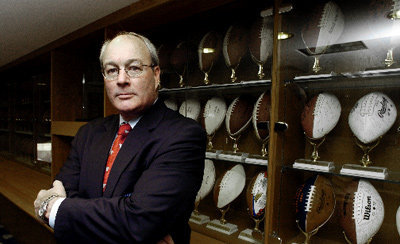
Paul Hoolahan
Sport: Administrator
Induction Year: 2015
Induction Year: 2015
Hoolahan’s shrewd leadership over 19 years has helped keep the Allstate Sugar Bowl among college football’s elite postseason contests. Hoolahan became the Sugar Bowl’s executive director in 1996 and has added the role of Chief Executive Officer of the organization, which not only hosts at least one of college football’s premiere games annually, but also stages a continuing series of events promoting high school and college sports around the state. Hoolahan has directed the bowl’s operations for 21 bowls, including five national championship games during his tenure in New Orleans. Most recently, he brokered an arrangement with the Southeastern Conference and the Big 12 Conference to host the top available teams from each conference in the Sugar Bowl through 2025 – except for when hosting four College Football Playoff national semifinal games, as it did in 2015. In Hoolahan’s nearly two decades with the Sugar Bowl, the organization has generated well over $2 billion for the local economy. During his tenure, the bowl has more than doubled its number of ancillary community events. In 2014, the Sugar Bowl took on title sponsorship of the Louisiana High School Athletic Association’s slate of state championship events. Hoolahan also spearheaded the Sugar Bowl’s involvement with New Orleans’ successful bid to host the 2012 NCAA Men’s Basketball Final Four, as well as the 2013 NCAA Women’s Final Four. In addition to its many events, the Bowl is also heavily involved with several other local organizations. The Allstate Sugar Bowl sponsors the Greater New Orleans Sports Hall of Fame, The Manning Award, given to the nation’s most outstanding quarterback, and the local chapter of the National Football Foundation and College Football Hall of Fame. It took over title sponsorship of the Crescent City Classic in 2012.
Hoolahan’s hand steers Sugar Bowl to greatest days
By Marty Mulé
Written for the LSWA
Don McCauley put it succinctly: “Paul inspires people through his leadership. He’s a natural leader, and he always has been.’’
He was discussing Paul Hoolahan, his old teammate at North Carolina and the guard he often followed into the line more than four decades ago. “Paul would just give a look in the huddle that said, ‘Follow me.’ He’d show the way.’’ In their senior season McCauley followed Hoolahan to the NCAA single-season rushing record of 1,720 yards, relegating O.J. Simpson to second place.
That type of hegemony has been the hallmark of Hoolahan’s two-decades tenure of keeping the Sugar Bowl in its place of prominence among college football’s elite postseason destinations.
It sometimes behind the scenes has been difficult, and at least once nearly disastrous.
That the Sugar Bowl, in a city with no Fortune 500 Companies and a high poverty rate, is still in the top tier of championship venues is largely due to its Chief Executive Director, Hoolahan. It’s also the reason Hoolahan, a native of Long Island, N.Y., is being recognized with the Louisiana Sportswriters Association’s Dave Dixon Leadership Award, which also puts him in the company of the state’s athletic giants with a place in the Louisiana Sports Hall of Fame.
Hoolahan has overseen the Sugar Bowl since 1996, and is a now rare administrator with hands-on experience through college football’s evolutionary phases of the Bowl Alliance, the Bowl Championship Series, and the College Football Playoff systems.
“You can’t look back at what he has done and not be impressed with Paul’s knowledge and leadership,’’ said another Tar Heel teammate, John Swofford, the commissioner of the Atlantic Coast Conference. “Paul is tremendously capable, a blend of smarts, toughness and with a big heart. He’s done a wonderful job for the Sugar Bowl and college football in general.’’
When Hoolahan, formerly the athletics director of Vanderbilt University, accepted stewardship of the Sugar Bowl in 1996, the game had money problems. The first game he oversaw, the Florida-Florida State national championship, lost money. “A national championship game should never lose money,’’ Hoolahan says now, with a tone of disbelief.
He had to straighten – meaning change – business matters with the Sugar Bowl’s partners. No easy task, and the Sugar Bowl would later receive criticism for enlisting minimal state aid, although the state is a major beneficiary of the game’s drawing power.
Later, after Hurricane Katrina flattened – and nearly drowned – New Orleans, the Sugar Bowl was in mortal danger. The torn Superdome was unusable, and there was a strong possibility there could be no Sugar Bowl in 2006. Had that happened, the Sugar Bowl as we know it, an elite postseason game, would have evaporated along with partnerships with the Southeastern Conference, ABC-TV, and the BCS.
That would have the Sugar Bowl’s death knell.
A month after the Sept. 5 storm, Hoolahan and some staffers received permission to enter the Dome, with masks to lessen the putrid smell after the building’s long period without electricity, to retrieve computer hard-drives where all the game’s vital information and contacts were stored – and went to work getting the Sugar Bowl on track.
With the help of the Atlanta Tourist and Convention Bureau and a helping hand from Peach Bowl personnel, the Sugar Bowl set up headquarters in Georgia. Hoolahan rounded up his staff, and started work. Despite losing six weeks to the circumstances, the staff and 50 Sugar Bowl members made up ground.
The result was a 38-35 West Virginia upset of Georgia, one of the best games in Sugar Bowl annals, and a game run virtually without a major hitch.
“Who wouldn’t be impressed with that performance – and I’m not talking about the teams,’’ Swofford said in admiration.
The third obstacle, in 2014, was directing the Sugar Bowl into prime position in the College Football Playoff system after the BCS evolved into the four-team playoff model for the title. With a rising tide of wealthier cities trying to buy their ways into the championship rotation – which had become a high-bidder’s auction – the Sugar Bowl, with probably less resources than any of its competitors, found its way back to the first rank of postseason games.
“We kept the bar high and we kept meeting that standard,’’ Hoolahan, who has overseen five national champion games, said. “This is the Sugar Bowl, a name that means something. For eight decades its name, tradition and history has meant something. It meant something to me, and I wasn’t from here, and it has meant something to college football. That’s not going to change if I can help it.’’
McCauley believes Hoolahan’s success comes in large part through sheer force of personality. “Paul inspires people through his leadership. To this day, he’s so intense about what he sees as his missions, which he takes on with honor and decency – and accepts no excuses. Let me tell you, once we were leaving the practice field, talking and I told him I was going out that night. He stopped me, looked me in the eye and told me seriously that I wasn’t studying enough lately. Hey, I was 21, who didn’t go out from time to time at that stage?
“I did go out . . . but, I have to say, I was a little afraid to come back that night – almost as if I didn’t want to face my parents. He knows what’s right, he works to make things right, and leads people on the right path. I believe he is special that way, and he has always been that way.’’

Recent posts
-
Kathy Holloway earns ’26 Dave Dixon Louisiana Sports Leadership Award January 8, 2026

-
Gil LeBreton, John James Marshall are 2026 sports journalism inductees in LSHOF January 7, 2026

-
Third year of impactful LSHOF membership drive launches November 4, 2025


