
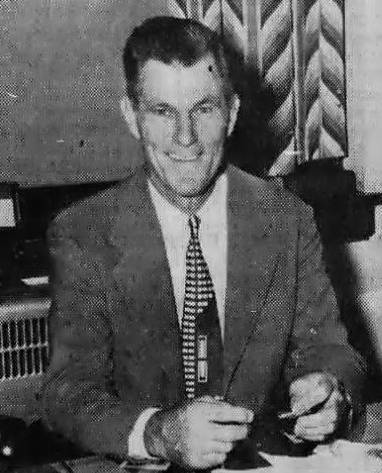
Paul Geisler
Sport: Football
Induction Year: 1967
University: Centenary
Induction Year: 1967
It was the golden age of Centenary College football, and Paul Geisler was the golden boy for Coach Homer Norton’s Gentlemen.
At 6-1 and 185 pounds, Geisler was one of the biggest players on a Centenary squad that sailed through the 1932 and 1933 seasons without a loss and shut out 10 consecutive opponents.
Who did they shut out? Start with the University of Arkansas in the 1932 finale, and add Baylor, LSU, Texas, TCU, Texas A&M, and SMU to the parade in 1933—along with such breathers as Louisiana Normal, Henderson State Teaches of Arkansas and Union of Tennessee.
Norton’s teams had 14 games with Southwest conference and Southeastern Conference opponents in those two seasons. The Gents allowed five touchdowns in those 14 games, but LSU and Texas A&M couldn’t score against Norton’s team in either year. Oklahoma finally broke the 24-game unbeaten streak in 1934.
Norton used the Gents’ success in 1932 and 1933 as the springboard to the head coaching position at Texas A&M, leading the Aggies to the national championship in 1939.
Paul Aubrey Geisler’s performances in Centenary’s 24-game unbeaten streak earned him berths on All-American teams selected by Grantland Rice, Collier’s Magazine and the wire services in his senior season.
Even by standards of the 1930s, Centenary had a small football team. Reserve tackle Pete Burt was the only 200-pounder on the 1932 team and sophomore Conway Baker—who would go on to a 10-year career in the National Football League—was the only 200-pounder in 1933. The only 190-pounders were tackle Morse Harper, at 6-4 the tallest player on the squad, Joe Oliphant and guard Robert Waters.
Quarterback manning Smith was the only Gent who had more playing time than Geisler in either season, and Smith had only 12 more minutes in 21 games. Both of them averaged 50 minutes a game. Geisler played 60 minutes in three games as a senior, and 55 or more in three others.
Although he was a two-time All-Stater at Morgan City High School, Geisler—nicknamed “Hoss”—spent his first two seasons at Centenary in relative obscurity as a back. When Norton moved him to an end position, his career blasted into orbit. LSU coach Biff Jones called him the best end he had seen since Gerry Dalrymple, a two time All-American at Tulane, “He is as fast as a streak,” and Jones.
The highlight of those two seasons—and of Centenary’s football history—was the Gents’ 6-0 victory over LSU in Shreveport on Nov. 12, 1932.
The Tigers were riding a streak of five consecutive shutout victories, and had allowed only one touchdown in their previous seven games. Their line was anchored by Roy Wilson, a product of Shreveport’s Byrd High, and 6-5, 260-pound “Baby Jack” Torrance. An impressive set of blacks included Joe Almokary, another Byrd High, another Byrd High product, and Haynesville’s Bertis Yates, who had enrolled at Centenary before transferring to LSU.
>
Both teams mustered two scoring treats, but the only one that got past the opponents’ 10-yard-line was Centenary’s 60-yard drive to the game’s only touchdown in the third quarter. Ralph Murff ripped off gains of 10 and 17 yards, and Smith scrambled for 17 to set up Murff’s one-yard plunge over the goal line.
Geisler turned a short pass from Smith into a long gain for Centenary’s other threat. But he was dragged down at the LSU 10 yard-line, and the Gents couldn’t get any closer on that series. “Hoss” also played a superb defensive game, breaking up a “Statue of Liberty” fake punt for a 15-yard loss.
Geisler scored five touchdowns in those two seasons as Eddie Townson and Murff led the 1932 Gents in scoring while Harold “Shorty” Oslin and Smith were the top scorers in 1933. Geisler was named to the All-Southern Intercollegiate Athletic Association teams both years, and was invited to play in the Shriners’ East-West charity game after his senior season.
A few months later, he received a contract offer from the Brooklyn Dodgers of the National Football League for $125 a game—an impressive sum at that time. But Geisler, needing six more hours for his degree, transferred to Louisiana College and completed his undergraduate work while he served as an assistant coach. He married Randle Johnson of Campti, whom he met at Centenary; wand went into high school coaching at Lake Providence and Tallulah. After a stint in the Air Force during and after World War II, he spent one year in college coaching (at Stephen F. Austin) before returning to Lake Providence as a high school principal and, a few years later, superintendent of schools. He died of a brain tumor in 1956 at the age of 47.

Recent posts
-
Kathy Holloway earns ’26 Dave Dixon Louisiana Sports Leadership Award January 8, 2026

-
Gil LeBreton, John James Marshall are 2026 sports journalism inductees in LSHOF January 7, 2026

-
Third year of impactful LSHOF membership drive launches November 4, 2025


