
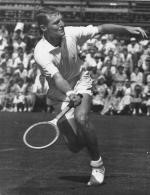
Hamilton "Ham" Richardson
Sport: Tennis
Induction Year: 1983
University: Tulane
Induction Year: 1983
Nobody will ever know how much Hamilton Farrar Richardson could have accomplished in tennis if he had continued serious competition after he was 25 years old.
By that time, he had won two National Collegiate Athletic Association singles championships and represented the United States on seven Davis Cup teams – including two that won the Cup with victories over Australia.
“A tennis player reaches his prime between 25 and 35 years of age,” Richardson said. “In 1958, when I was 25 and one of the top players in the country, I went into business. Since then, I’ve primarily been a weekend player, although I’ve been able to win some when I had the time to prepare.”
He grew up in Baton Rouge, attending University High, and excelled in basketball and baseball. But from the time his dad introduced him to tennis at the age of 11, he dreamed of playing at Wimbledon.
When Ham Richardson was 15 years old, a doctor told him he would have to stop playing competitive tennis because he was a diabetic. Richardson went to another doctor, who said the same thing. So he sought a third opinion. “When I finally found one who said I wouldn’t have to give it up, my tennis picked up right where it left off,” he recalled.
One year later, although he was 15 pounds underweight because of the diabetes, he reached the national junior finals – the best showing for a Louisiana player in 35 years. The following year, he climaxed a perfect junior campaign by becoming the state’s first national junior champion.
“He’s the best tennis prospect in 25 years,” said Him Bishop, president of the United States Lawn Tennis Association.
By that time, Richardson already was traveling to New Orleans each Saturday to train under Tulane coach Emmett Pare at the New Orleans Lawn Tennis Club. “He was a touch taskmaster who made his students work very hard on the fundamentals,” Ham recalled. “He’d drill, drill, drill until a player was comfortable with a shot.”
As a teenager, the 6-foot, 158-pound Richardson won an exhibition match with 1949 Wimbledon champion Ted Schroeder and threw scares into Earl Cochell and Herb Flam. He needed only 36 minutes to win the championship match in the National Interscholastics.
In 1951, Richardson’s childhood dream came true when his mother took Ham to Wimbledon. But special arrangements were necessary because of his diabetes. With Britain still rationing food after World War II, they had to go to the U.S. Embassy for milk. Meat was sent from home. Budge Patty, the defending champion, was Richardson’s doubles partner. They faced one another in the second round of single play. Making small talk during the limousine ride from their hotel to the All-England Club, Patty asked Richardson if he thought there would be any good matches that day.“At least one,” the youngster replied.
He was right. Richardson used a brilliant backhand and cool head to eliminate the defending champion 4-6, 6-4, 4-6, 10-8, 6-4.
After the match, he found out about the London press. “The London press was a little crazy those days,” he recalled. “They treated Wimbledon champions like some treat rock stars today.” Modern day stars such as John McEnroe might respond, “The more things change, the more they stay the same.”
When the London reporters learned about his diabetes, they used such melodramatic lines as “Invalid Boy Beats Patty” and “Sick Lad Advances.” Richardson won one more match at Wimbledon that year before bowing to Brazil’s Armando Viera.
There was no doubt that he would attend college at Tulane, the perennial Southeastern Conference champion at that time. “Tulane was just far enough from home that I could get loose, just close enough to get back home,” Richardson said. “Tulane is a fine school, and there was no Emmett Pare anywhere else.”
By the time he enrolled at Tulane, he was the ninth-ranked amateur tennis player in America. He won 58 of 60 singles matches and four Southeastern Conference No. 1 singles titles during his career – a feat that no other SEC player ever matched, before or since. He led the Green Wave to four more SEC team championships.
The only blemishes on his collegiate record in singles play were losses to Tony Trabert of Cincinnati and Sammy Giammalvo of Texas. Trabert was the 1955 Wimbledon champion and two-time U.S. Open champion. “I think I shall retire,” Pare said after Richardson’s last collegiate match.
In the classroom, despite missing many classes because of tennis trips, he had a perfect record except for two Bs – one in French and the other in a physical education first aid course. He became a Rhodes Scholar after completing his undergraduate work in three years.
In 1958, Richardson teamed with Alejandro Olmedo to win the doubles championship in the U.S. Open. Richardson was ranked No. 1 in amateur tennis in both 1956 and 1958. But the U.S. Open didn’t allow professionals to play until 1968, and pro tennis tournaments in the late 1950s weren’t as attractive financially as they are now. It was a game for hustlers making extra money with exhibitions between tournaments. Rather than become a tennis “bum,” Richardson decided to get on with the rest of his life.
In recent years, he has been a New York-based oil investor and weekend tennis player. In 1983, he was the first tennis player to be inducted into the Louisiana Sports Hall of Fame.

Recent posts
-
Louisiana Sports Hall of Fame announces star-studded 2027 induction class September 9, 2026

-
Hall of Famer Jerry Stovall passes away at age 85 August 31, 2026

-
Passing of a legend: LSU’s transformational Skip Bertman dies at 88 August 14, 2026


