
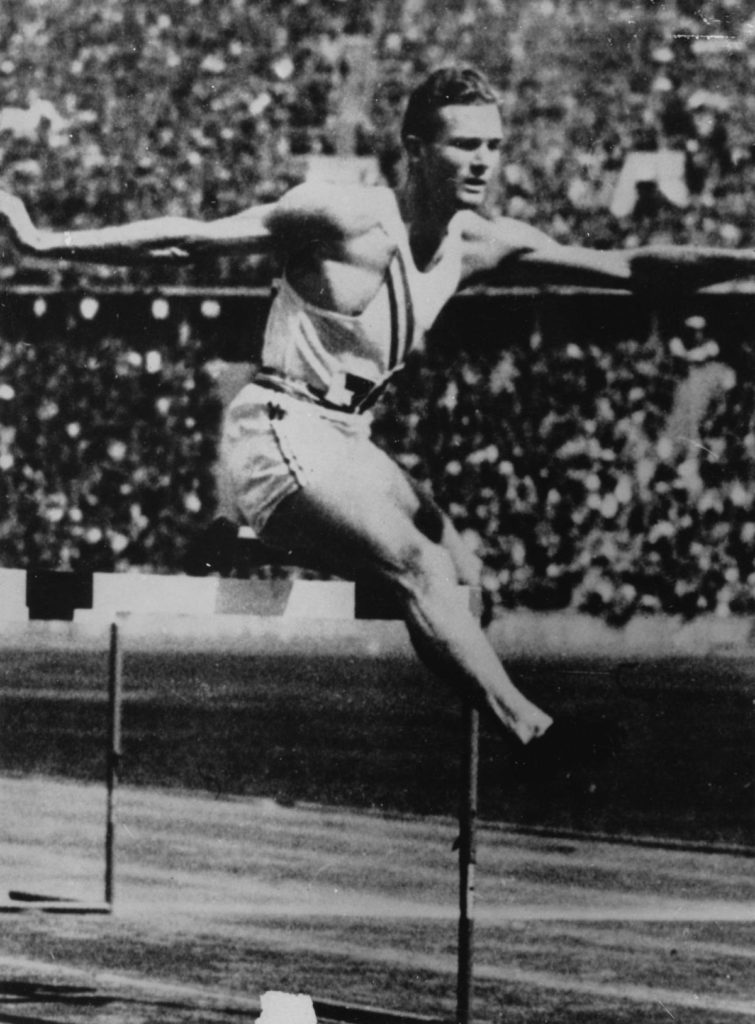
Glenn "Slats" Hardin
Sport: Track and Field
Induction Year: 1962
University: LSU
Induction Year: 1962
Competing in the 400 meter hurdles in the 1932 Los Angeles Olympics and the 1936 Berlin Olympics, Glenn “Slats” Hardin of Louisiana State university collected one world record and one gold medal—but not in the same meet.
His first world record performance came in the finals of the Los Angeles Olympics, when Hardin was second behind Robert Tisdall of Ireland.
Another American, Morgan Taylor, equaled his own world record time of 52 seconds flat, but finished behind both Tisdall and Hardin. Tisdall’s 51.7 was not allowed as a world record because he knocked over the final hurdle and stumbled for five or six yards before regaining his balance. The existing rules (which were not changed until 1938) disallowed records by athletes who failed to clear a hurdle. Hardin’s 51.9 was recognized as the world record, although he had to settle for the silver medal.
Hardin needed a special ruling to make the 1932 Olympic team, because he was disqualified in the national AAU championships (the qualifying meet for the Olympics) for running out of his lane. Hardin finished first in that race, beating Joseph Healey and Taylor, and was placed on the U.S. team despite the disqualification.
Hardin never lost another 400 meter hurdles race after the 1932 Olympics, dominating the event to the same degree that Edwin Moses dominated it in the late 1980s. On July 26, 1934, competing in Stockholm, Hardin sliced a full second off his own world record with 50.6—setting a mark that would stand for 19 years.
Hardin credited a young Swedish competitor with helping him set the record. “Slats” drew the eighth lane, which he despised because he wouldn’t be able to see anybody else. But the Swede, who had lane two, offered to switch with him.
“I can’t beat you,” the youngster said, “but I would like to run in a race where the world record is set.”
Hardin was happy to make his wish come true.
“Slats” was nearly two seconds over that time in the Berlin Olympics, but his 52.4 was good enough for the gold medal.
When LSU won the 1933 NCAA championship at Chicago’s Soldier Field, five athletes scored points for Coach Bernie Moore’s Tigers and three of them scored in two events. But Hardin was the only Tiger who WON two events in that meet.
>
In the 440-yard dash, he lowered the meet record to 47.1 seconds as he finished a yard ahead of runner-up Ivan Fuqua of Indiana.
Hardin’s chances for a double in the 220 yard low hurdles got a boost when two-time champion Jack Keller of Ohio State, considered the “greatest hurdler the world has ever known,” crashed into a hurdle in a qualifying heat of the 120-yard high hurdles and suffered an injury which removed him from both events.
Hardin won the even with a clocking of 22.9 seconds, two-tenths of a second slower than Keller’s year-old record.
That was the legendary “five-man team” for LSU, but five other Tigers participated in the NCAA meet and Moore was expecting points from one of them—Ted O’Neal in the 880-yard run. Other LSU athletes who didn’t score were Pete Burge in the 440, Red Lehmann and Johnny Sanders in the 880 and George Fisher in the high hurdles.
Hardin was a 6-2, 162-pound All-State halfback at Greenwood High in Calhoun County, Miss. He also developed into one of the nation’s best prep hurdlers under the tutelage of Greenwood track coach William Octavius Spencer, who set the American record in the steeplechase in 1928 to qualify for the Olympics.
Legend has it that Hardin learned to run by racing alongside railroad tracks, hurdling fences with watermelons under each arm.
The Brown brothers, James (“Big Fuzzy”) and Ellis (“Little Fuzzy”), played key roles in recruiting Hardin for LSU. “Little Fuzzy” was coaching at Picayune, Miss., and was well aware of Hardin’s talent.
A couple of weeks after the 1933 NCAA championships, Hardin won the first of his three national AAU titles in the 400 meter hurdles with a clocking of 52.2 seconds. He lowered his world record to 51.8 in the 1934 national AAU meet and lowered the meet record to 51.6 in 1936.
He won the 440-yard dash and 220-yard low hurdles again in the 1934 NCAA championships, lowering his 440-yard dash record to 47 seconds flat (his lifetime best was 46.8) and tying Keller’s 22.7 record in the 220 low hurdles.
An Athlete who was competing for East Technical High of Cleveland, Ohio, in a national interscholastic meet at Soldier Field while LSU was winning the 1933 NCAA title would be the NCAA champion in the 220 low hurdles in 1935 and 1936, respectively, but he didn’t equal Hardin’s times, His name was Jesse Owens.
Hardin befriended Owens during the 1936 Olympic team’s voyage to Europe, and Owens came to Baton Rouge nearly 50 years later as guest speaker at a banquet for the establishment of the Glenn “Slats” Hardin memorial scholarship at LSU.
“Slats” Hardin never had an opportunity to run the 400 meter hurdles in an NCAA meet, but his son—Billy Hardin—won the 1964 NCAA title with 50.2 seconds. Billy Hardin also won the AAU title in the 1964 with 50.1, but Rex Cawley (who finished fourth in the AAU meet) won the gold medal in the Tokyo Olympics that year.
Both Hardins also took individual scoring honors in conference meets. “Slats” won the 440-yard dash in the first three SEC meets and ran on two winning mile relay teams, helping Moore’s Tigers win team titles all three years.
When Hardin broke the world record in the Los Angeles Olympic the following year, Moore—an assistant coach for the United States team—suggested that it might not be a bad idea if he didn’t try to make the football team.
Moore became head football coach at LSU in 1935, and tried to persuade Hardin to reconsider playing football.
“You’ve had me running in a straight line for three years,” Hardin told him, “and now you’re trying to get me back running in a crooked line. No, I’m not going to do it.”
By that time, Hardin felt his future was in track and field. The Olympic gold medal in the Berlin Games a year later confirmed that belief.
Hardin died on March 6, 1975, at the age of 64.

Recent posts


