
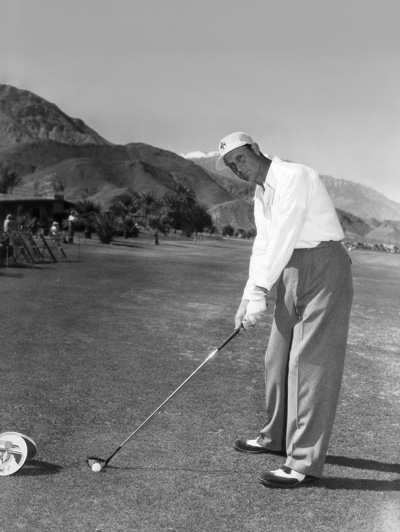
Fred Haas, Jr.
Sport: Golf
Induction Year: 1978
University: LSU
Induction Year: 1978
Growing up in Dermott, Ark., in the early days of the Great Depression, Fred Haas, Jr. needed an athletic scholarship to attend college.
His father, who was in the cotton business, enjoyed playing golf as a young man and suggested that it might be the best opportunity to provide his son’s college education.
All they had to do was build a golf course.
Young Haas also played on the Dermott High basketball team, but golf was his first love. He developed his game on the six-hole, sand green course that he helped his father build, and won Arkansas high school titles in 1932 and 1933—earning a scholarship to the University of Arkansas.
Then his dad became the pro at Morehouse Country Club in Bastrop, just across the Louisiana state line. An uncle, state senator Leo Terzia, took young Haas to the Louisiana stat amateur tournament in Baton Rouge and the 17-year-old Haas reached the finals before bowing to Bobby Anderson, a freshman at Louisiana State University.
Terzia brought former governor Huey Long to the finals. After the exciting duel between two youngsters with so much college eligibility remaining, Long saw a possibility for a national golf championship for his beloved LSU.
“Forget about your scholarship to Arkansas,” Long told Haas, “and get the recruits we need to win the national championship here.”
“The first thing we’ll need is a golf course,” young Haas suggested to Long, who was then U.S. senator.
“Where?” asked Long.
“I saw a lot of cows grazing across the street from the stadium,” Haas said. “That would be a good place.”
“Son,” Long replied, “LSU is an Agricultural and Mechanical school. If I moved those cows, the farmers would be very upset.”
Two years later, LSU bought the Westdale Country Club for $25,000. Many years later, the school sold the course to Baton Rouge for $750,000 and built a golf course on the LSU campus—where Haas had seen the cows grazing in 1933.
Shortly after his son enrolled at LSU, Fred Haas, Sr. also moved to South Louisiana as the golf pro at Harahan’s Colonial Country Club. He saw his teenage son win the Southern Amateur at the New Orleans Country Club in 1934.
The same year, young Haas played in an exhibition match with Bobby Jones at the Metairie Country Club and Jones invited him to play in the very first Masters tourname3nt.
In 1937, two years after Long’s death, the national championship that Long had envisioned four years earlier became a reality at Oakmont Country Club in Pittsburgh as Haas beat teammate Paul Leslie for the individual title. It was the only time two golfers from the same school reached the national finals.
Haas won approximately 125 amateur tournaments, including the 1934 and 1938 Southern championships, before he decided to turn pro at the age of 35.
He made that decision after he won the 1945 Memphis Open as an amateur, snapping Byron Nelson’s streak of 11 consecutive Professional Golf Association victories.
“I didn’t want to wake up at 50 and wonder if I could have won another PGA title,” he said.
He didn’t have to wonder long. In his first year, he won the Miami Open, the Long Beach Open, the Portland Open (in a playoff with Ben Hogan and Arnold Palmer), the Peoria Open and the Thunderbird Open in Palm Springs.
In 1948, the year Hogan won his first U.S. Open, Haas led Hogan by five shots going into the final round of the Reading, Pa., Open. But Hogan chipped in for an eagle on the second hole and went on to a 64 round, setting a 72-hole record total of 269 as Haas—who was 16 under par after three rounds—came up one stroke short with a two under-par 70.
In that pre-televised era, the difference between first and second was $700. Hogan’s victory was worth $2,600, enabling him to keep the top spot on the 1948 money list with $22,797. Haas picked up $1,900 for finishing second. “Our winnings were anemic,” Haas recalled, “but our expenses were small.”
That was one year before the automobile accident that interrupted Hogan’s career—and his courageous comeback that produced three more U.S. Open titles in a span of four years. Haas trailed Hogan by only five shots until the last four holes of the third round in the 1953 U.S. Open at Pittsburgh-but lost two shots to par in those four holes.
Haas’ official career earnings were listed at $154,00, although PGA records did not date back to 1946.
The best competitive round of his PGA career was a 62 in the final round of the Cleveland Open, enabling him climb from 56th place to fourth.
In 1938, Haas played on the United States Walker Cup team captained by Francis Ouimet, but came out on the short end in both singles and foursome play at Scotland’s St. Andrews course as Great Britain and Ireland chalked up a 7-4 victory over the visiting Yanks.
Fifteen years later, he became the first golfer to play in both the Walker Cup (amateur) and Ryder Cup (pro) matches, playing a five-under-par round at the Wentworth course near London. But he lost a 3 and 2 decision to Harry Bradshaw. That time, however, the American team captained by Lloyd Mangrum scored a 6-5 victory.
Haas had enough points to make the Ryder Cup team in 1948 and 1950, but at that time a golfer had to be a pro for five years and a member of the PGA to play in the matches.
In 1966, he won both the PGA senior championship and the world senior championship, beating England’s Dai Reis 3 and 2 in Scotland
Haas had a career total of four holes-in-one—two of them on the fly.
Haas and his wife, the former Paula Howard of Shreveport, raised two sons and one daughter. Haas, his three children and son-in-law Tim Cloudman operated a sports surface company in New Orleans in recent years.


