
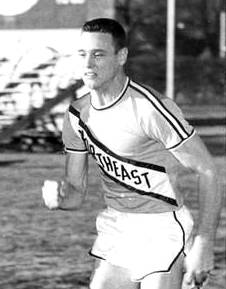
Don Styron
Sport: Track and Field
Induction Year: 1977
University: UL-Monroe
Induction Year: 1977
When he won three gold medals in the 1956 Melbourne Olympics, sprinter Bobby Morrow relied on getting 11 hours’ sleep a night to keep up his strength.
Four years later, twin brothers Don Styron and Dave Styron used the same strategy to rank among the world’s best athletes in the specialties.
They might have a combined total of 11 hours’ sleep before major meets – 5 1/2 apiece for Don and Dave.
“If they got three or four hours sleep,” recalled former teammate Jerry Dyes, “they could run with anybody in the world.”
Former LSU track and field coach Murrell “Boots” Garland, who considered himself somewhat of an authority on the subject, said the Styrons’ reputation for being world class drinkers was greatly exaggerated. “They did plenty of carousing, but not much drinking,” Garland said. “I’ve spilled more liquor on the bar than they ever drank.”
Lew Hartzog, who coached the Styrons at Wheat Ridge, Colo., High School and Northeast State College (Northeast Louisiana University, Univ. of Louisiana-Monroe) was a great track coach, but he didn’t exactly run a tight ship. Any of his athletes would’ve had a hard time matching their coach’s reputation as a free spirit.
When Hartzog took the Styrons and Dyes to the 1960 Olympic Trials at Stanford by automobile, they were on the road for four weeks – with a two-day layover in Juarez, Mexico, highlighted by Hartzog’s leap from a second-floor balcony into a motel swimming pool.
“Looking back,” Dyes recalled when the Styrons were inducted into the Louisiana Sports Hall of Fame in 1977, “I don’t think stopping in Juarez was a very good idea.”
In the Olympic Trials, the field for the 400-meter intermediate hurdles was the fastest ever assembled.
It included world record holder Glenn Davis, the defending Olympic champion, and the other two medalists in the Melbourne Game – Eddie Southern and Josh Culbreath. Whoever qualified for the U.S. team would be part of another 1-2-3 sweep in Rome.
Don Styron, running the event for only the sixth time in his life, had a personal best of 49.9. Leading the pack at 300 meters, he hit the eighth hurdler and lost his balance for a few strides.
“I lost my concentration, and wasn’t able to get my rhythm back,” he recalled. Despite the mishap, he finished sixth with 50.3 – one-tenth behind Culbreath. Davis won in 49.5 and the next three broke 50 seconds – but Southern, Culbreath and Styron didn’t make the team.
The following spring, Northeast won the Florida Relays as Dave Styron won the 100, Don Styron won the high hurdles and both ran on winning 440-yard and mile relay teams. The Indians rolled up 50 1/2 points to 28 for runner-up Florida.
When Northeast beat LSU’s Southeastern Conference champions 55-53, the Styrons accounted for 36 points. Don Styron had a personal best in the high hurdles that day, beating Dickie Durham of LSU with 13.9.
Later in the 22-yard low hurdles, he lowered the world record to 21.9 seconds.
The 220-yard low hurdles was a standard collegiate event at that time, but it was dropped in favor of the 440-yard intermediate hurdles.
Two years in a row, Track and Field News selected Don Styron as the world’s best triple hurdler – combining the 120-yard highs, 220-yard lows ad 440-yard intermediate hurdles. He was the national AAU champion in the 220-yard lows in 1961, the next-to-last time the event was held in a national meet.
Don Styron won his first race with his younger brother on March 18, 1940, when he was born 20 minutes before Dave.
The twins played football and basketball at Wheat Ridge, Colo., and also participated in track and field. But they enjoyed only modest success. In the 1957 state meet, Don Styron was second in the 180-yard low hurdles and Dave Styron was third in the broad jump (now the long jump).
When Hartzog got the Northeast job a couple of months later, he located the Styrons working on a summer job at hay and cattle ranches near Jackson Hole, Wyoming, and gave them the only scholarship offer they received from a four-year school.
At Northeast, they had to build a track before they could build one of the nation’s best collegiate teams. “We had to borrow hurdles from Neville High and practice on the football field,” Don Styron recalled.
Social barriers also blocked their development as world-class athletes, because a Louisiana law did not allow state schools to participate in integrated events at that time. That prevented Northeast from winning national titles, and cut down on its athletes’ opportunities for top competition.
The Styrons shared Gulf States Conference “Athlete of the Year” honors three years, leading the school to its first three conference titles in any sport.
Two years after he completed his collegiate eligibility, Don Styron tried to come back and win a berth on the 1964 U.S. Olympic team. In the 400-meter intermediate hurdles, he was runner-up to Eddie Southern in the Texas Relays and runner-up to Cliff Cushman in the Kansas Relays. But the Amateur Athletic Union offered little of no help to world class athletes after their collegiate eligibility expired, and his comeback bid ended in frustration and failure.
He was able to fly to Corvallis, Oregon, for a qualifying meet, and finished second. But he ran out of money, and the AAU officials – who promised per diem expenses to the top three in each event – said they would mail a check.
Meanwhile, Don had to hitchhike to Los Angeles – where Southern Cal coach Jess Mortensen allowed him to stay in the athletic dorm while he trained with USC athletes, and then hitchhike across the nation to compete in the Olympic Trials at New Brunswick, N.J. But the time he arrived in New Brunswick, he had lost his conditioning and finished last in a qualifying heat.
More than 25 years later, he was still waiting for the check.

Recent posts
-
Kathy Holloway earns ’26 Dave Dixon Louisiana Sports Leadership Award January 8, 2026

-
Gil LeBreton, John James Marshall are 2026 sports journalism inductees in LSHOF January 7, 2026

-
Third year of impactful LSHOF membership drive launches November 4, 2025


