
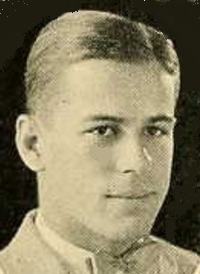
Charles "Peggy" Flournoy
Sport: Football
Induction Year: 1968
University: Tulane
Induction Year: 1968
Charles “Peggy” Flournoy, Tulane University’s first All-American football player, played for Green Wave teams coached by Clark Shaughnessy from 1923-1925. In those three seasons, Tulane chalked up 23-4-2 record- with three of the four losses in 1923, when Flournoy was a sophomore.
His 40-yard touchdown pass to Alfred “Brother” Brown was a key play in the Green Wave’s 20-0 victory over LSU in 1923. A year later, with LSU dedicating its new stadium, Flournoy scored the first touchdown and then punted out of danger after the Tigers drove 70 yards only to come up two yards short of the Green Wave goal line. LSU didn’t threaten again in a 13-0 loss witnessed by a near-capacity crowd of nearly 20,000 spectators- at that time, the largest gathering ever to watch a game in Louisiana.
Tulane’s most important victory in the 1924 season, however, was its 21-13 win over defending Southern Conference champion Vanderbilt, which was considered the “Notre Dame of the South” at the time.
“The Commodores were the yardstick by which you measured your club,” recalled Tulane quarterback Lester Lautenschlaeger.
By winning that game, Tulane established itself as the premier team in the South. But most of the highlights of Flournoy’s career were still a year away.
As a senior, he led the nation in scoring with 128 points (still a school record, although it was tied by Bill Banker three years later) and led the Green Wave to an unbeaten season.
He played before statistics were kept in other individual categories, but several of Flournoy’s scoring records are still intact. He scored four touchdowns in one game (against Louisiana Tech), 19 touchdowns in one season (1925) and 16 rushing touchdowns the same year. He had career totals of 25 touchdowns and 168 points- a record that Bill Banker broke several years later.
Flournoy was a triple threat halfback, equally effective running inside and outside, and he handled the place kicking as well as punting.
He first attracted national attention with a brilliant performance in an 1807 upset victory over Northwestern’s Wildcats in the middle of his senior season.
Harry McNamara, covering the game for the Chicago Herald Examiner, wrote: “Peggy Flournoy, lean, lanky fellow who held forth at left half for the Southerns, made Stagg Field a turbulent green sea for the so-called Purple Wildcats all through the battle. It is doubtful whether the great Red Grange in his palmist days ever played better than this same Flournoy did. Peggy was a marvel in a broken field, a superb human battering ram at a bucking line, his kicking was superb and his passing marvelous. Northwestern will always remember Flournoy, and so will the 18,000 spectators who came to see Tulane slaughtered, but went away singing the praises of Tulane.”
In addition to scoring all three touchdowns on short runs, Flournoy averaged 54 yards on eight punts- one of them a booming 70-yarder.
The only team that scored against Tulane in its five remaining games was Louisiana Tech, which dropped a 37-9 decision to the Green Wave. The other four victories- against Auburn, Sewanee, LSU, and Centenary- were shutout wins by margins ranging from 13 to 16 points.
With a record marred only by a 6-6 tie with Missouri, the Green Wave became the first Southern team to receive a Rose Bowl invitation. It also became the first Southern team to turn down a Rose Bowl invitation.
Officially, the administration claimed it would take the athletes away from their classrooms too long. Off the record, board members said they felt the Tulane players were too small to compete against Washington. So the bid went to Alabama, which scored its first bowl victory with a 20-19 win over the Huskies.
Tulane got a raking-over in the press for its decision to turn down the bid, and many observers felt the snub cost another unbeaten Green Wave team a Rose Bowl bid four years later.
Flournoy was selected by the Veterans Club of America as the most valuable player to his team in the 1925 season, and went to Philadelphia to accept the award. Before the Heisman Trophy came along, the award probably was the top individual honor a collegiate player could receive.
Shaughnessy stayed at Tulane only one year after Flournoy completed his career. He later coached at Loyola, the University of Chicago, Pittsburgh, and Stanford, developing such great players as Jay Berwanger (the firs Heisman Trophy winner) and Frankie Albert, who led the 1940 Stanford team to a perfect season that included a Rose Bowl victory over Nebraska. But Shaughnessy said he never had a trio of backs on one team who were better than Flournoy, Lautenschlaeger and Brown on the 1925 Tulane powerhouse.
In addition to wining the All-American honors in 1925, Flournoy was All-Southern Conference in both 1924 and 1925. When Tulane fans selected an all-time Green Wave team in 1978, more than a half century after his career ended, they chose Flournoy as the punter.

Recent posts


