
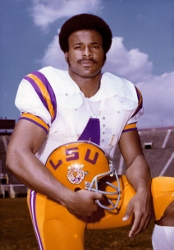
Charles Alexander
Sport: Football
Induction Year: 1993
University: LSU
Induction Year: 1993
By Sheldon Mickles
The Morning Advocate
When an athlete is elected to a hall of fame, he often reminisces about the good games and good times that helped get him there. But Charles Alexander, one of this year’s inductees into the Louisiana Sports Hall of Fame, vividly remembers the game that could have qualified him for the hall of shame.
It happened on Sept. 13, 1975, the day Alexander began an All-American career with the LSU football team.
On that particular day, however, the freshman from Galveston, Texas wasn’t exactly everybody’s All-American when he squared off with the Nebraska defense.
“I’ll never forget that game,” said a modest Alexander, who still chuckles about his debut nearly 18 years later. “It was sort of like ‘Welcome to college football.’ I can remember my stats like it was yesterday.”
Alexander, a strapping 6-foot-1, 226-pound tailback with sprinter’s speed, was tossed around the Memorial Stadium turf like a rag doll that day. He finished the game with eight carries for minus-2 yards and enough bruises to last the season.
“I don’t think I made it back to the line of scrimmage all day,” Alexander said of the game, which LSU lost 10-7. But that certainly wasn’t typical of Alexander’s stellar career at LSU and later with the Cincinnati Bengals of the National Football League. He usually dished out more punishment that he took, running away from huge defensive linemen and linebackers and simply overpowering defensive backs who tried to bring him down.
He finished his college career with 4,035 rushing yards- a school record at the time- and went in to pickup 2,645 more in seven seasons with the Bengals.
Even today, Alexander admits he would never have believed he could do that after his rugged college debut. In fact, he said he set his sights on three simple goals he set for himself when he left Ball High School, unheralded and unproven. “I wanted to earn a degree, have some fun playing football at LSU … and go home to coach high school football,” said Alexander.
He accomplished the first two, but came up way short on the final one. Instead of becoming a coach, Alexander became a first-round draft choice of the Bengals (he was the 12th player selected in the 1979 draft) and was a starting running back for most of his career. That wasn’t too bad for an athlete who didn’t gain 1,000 yards in his entire prep career and who was sought by no more than a handful of colleges.
“I really didn’t get an opportunity to show my ability,” said Alexander, who now serves as assistant director of LSU’s Tiger Athletic Foundation. “I had three different coaches in high school, and I was a blocking back.”
College recruiter
But there was at least one college recruiter who saw the raw talent that Alexander possessed- then LSU running backs coach Jerry Stovall. Stovall had been tipped off about Alexander by a track coach who had gone to Galveston to recruit Ball track star Greg Edmonds.
Until then, Southwest Conference schools were the only ones interested in Alexander, who was a junior at the time. Several months later, when recruits could sign two letters of intent before signing the binding national letter, Alexander went with LSU and the University of Houston.
When national signing day rolled around, Alexander had to choose between venerable UH coach Bill Yeoman and Stovall.
“Coach Yeoman was in his car and Coach Stovall was sitting there waiting in his car,” Alexander recalled. “It amazed me that Jerry was so persistent because I had told him no at least a dozen times. But thank goodness he (Stovall) was out there that particular day because I might have made the wrong decision and gone to Houston,” he added.
Alexander still doesn’t know why he picked LSU, except maybe that Stovall offered him trust and genuine chance to be a big-time running back. It didn’t take that long to realize he made the right decision.
“As soon as I got here, I knew it was the place for me,” he said from his Tiger Stadium office. “I liked the atmosphere of the stadium and all the tradition. It was a great place to play football and get an education.”
Alexander played his first two years behind Terry Robiskie, but still piled up 1,177 rushing yards- including 876 yards and seven TDs as a sophomore. He made four All-American teams in 1977 and five in ‘78 when he rushed for 1,686 yards and 1,172 yards, respectively. Alexander averaged 4.7 yards per carry during his career and scored 42 Tds. He also set nine Southeastern Conference records and 27 school marks, including most rushing yards rushing in a game (237), most rushing yards in a season (1,686) and most rushing Tds in a game (4) and season (17).
The four biggest games of his career came during that junior season in 1977. He rushed for 237 yards against Oregon, 231 against Wyoming, 199 against Tulane and 183 against Vanderbilt- all Tiger victories.
“My junior year was my favorite,” he said. “My senior year was disappointing because I pulled a hamstring and wasn’t healthy for about half the year. But as a whole, my time at LSU was the best four years of my life.”
Made easier
They were made easier, he said, by a hard-working offensive line known as “Charlie’s Angels,” but a group which preferred to be called “The Roothogs.” Some 15 years later, Alexander can’t talk about his record-breaking career without mentioning center Jay Whitley, tackles Chris Rich and Robert Dugas, guards William Johnson and Craig Duhe, tight-end Cliff Lane and fullback Kelly Simmons.
“It all started up front,” Alexander said modestly. “You can have all the ability in the world, but you really don’t have anything if you don’t have the guys up front.”
As a pro, Alexander didn’t enjoy the success he had at LSU, but he did have an outstanding season in 1980 with 701 yards rushing (4.2 average) and 36 pass receptions for 192 yards. The next season, he started in the Super Bowl XVI when the Bengals lost to the San Francisco 49ers, 26-21.
The game he remembers most is the one that got the Bengals to the Super Bowl. In minus-12 degree weather, they downed the San Diego Chargers to make it to the big game.
“The wind-chill was 59 below the day before the game, and we were out there practicing,” Alexander said. “After about 20 minutes, (owner) Paul Brown came on out and told (coach) Forrest Gregg to get us out of there. That never happened before.
“The next day was very uncomfortable. Everything on the sidelines froze: the players, the water, the Gatorade, everything.”

Recent posts
-
Louisiana Sports Hall of Fame announces star-studded 2027 induction class September 9, 2026

-
Hall of Famer Jerry Stovall passes away at age 85 August 31, 2026

-
Passing of a legend: LSU’s transformational Skip Bertman dies at 88 August 14, 2026


