
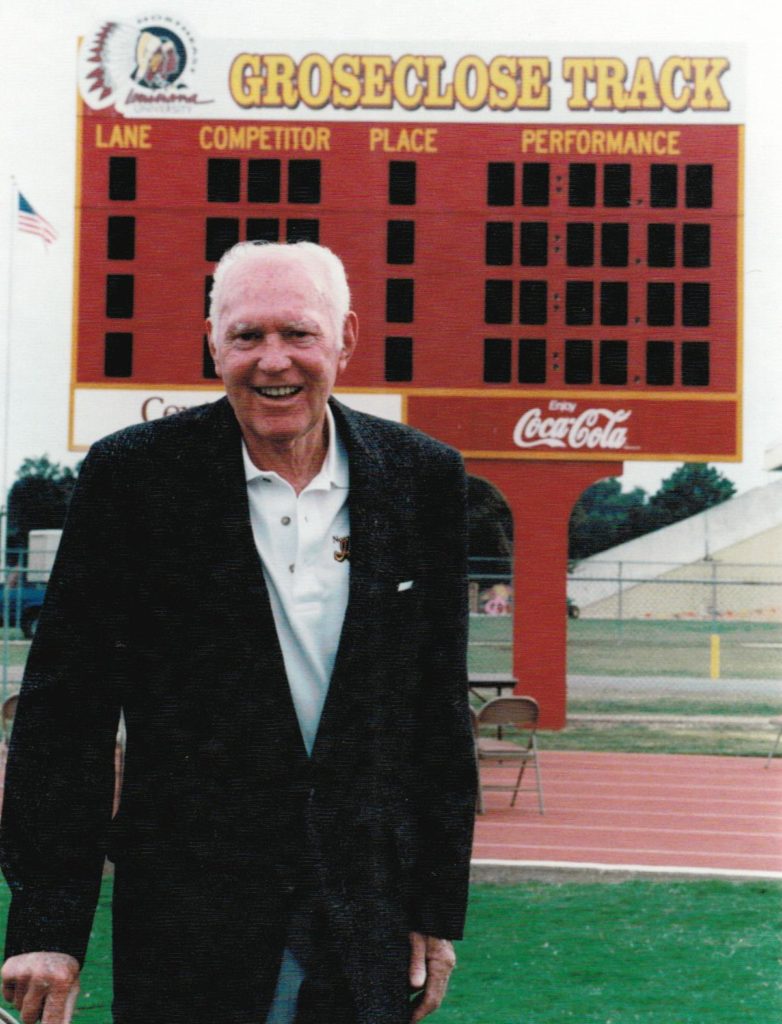
Bob Groseclose
Sport: Coach
Induction Year: 1992
Induction Year: 1992
His mother died when he was 11 months old and his father died 14 years later—when Bob Groseclose was preparing to enter his junior year at Breckenridge, Texas, High School.
In the middle of the Great Depression, the 15-year-old Groseclose didn’t know where he would spend the night when he went to his dad’s funeral.
The Breckenridge coach, Eck Curtis, approached him after the funeral. “If you want to stay in school and finish your eligibility,” Curtis sad, “I’ll take care of your room and board.”
In 1940, while he was a senior at Texas Christian University, Groseclose launched a coaching career that finally ended when he retired in 1989.
“They gave me a job coaching junior high teams for five dollars a day,” he recalled. “That was twice as much as I’d been able to make working in the summer. I decided to devote my life to helping other kids like Coach Curtis helped me.”
In the late 1950s, Lew Hartzog developed one of the nation’s strongest track and field teams at little Northeast Louisiana State College. But when he left to take over the coaching reins at Southern Illinois, three world-class athletes—twins Dave and Don Styron, and versatile freshman Jerry Dyes—also left.
Jack Rowan, the head football coach and athletic director a Northeast Louisiana, wanted to keep the track program at the level it reached under Hartzog. He contacted two of the nation’s best-known track coaches, Clyde Littlefield of Texas and Oliver Jackson of Abilene Christian, and told them he wanted to get the best track coach in Texas.
“The best track coach in Texas,” they told him, “is a high school coach—Bob Groseclose of Abilene.”
Groseclose’s team had captured three Class 4A state titles. He also was an assistant football coach for an Abilene team that set a national record with 49 consecutive victories and won three state titles.
“Everything was torn up when I got here,” he recalled after 29 seasons as the Northeast Louisiana track coach. “But eventually I got all of them back except Dyes.”
Louisiana Tech won the Gulf States Conference championship in his first year, beating Northeast Louisiana by four points. In the next 10 years, Northeast Louisiana and Southwestern Louisiana dominated the GSC. Each won five titles and Northeast Louisiana finished second in each of the other five years.
The first GSC championship, with the Styron twins returning for their final year of eligibility, was one of the highlights Groseclose recalled when he stepped down.
Other highlights were the world record performances of pole vaulter John Pennel, the first man to clear 17 feet, and the school’s first NCAA Division 1 national champion, high jumper Warren Shanklin. Later, Shreveport’s Andre Ester won two consecutive NCAA indoor championships in the long jump, and would’ve broken Carl Lewis’ record in the NCAA outdoor meet if he hadn’t fouled by a quarter-inch on his first attempt.
To say the least, track and field came a long way during the 61years that Groseclose was an athlete and coach. He never had a set of starting blocks until his senior year in high school. Before that, Groseclose and other athletes used trowels to dig their own holes in the track at the starting line.
Injuries in his freshman and sophomore years ended his football career, but Groseclose competed in basketball and track throughout his college career and was elected team captain in both sports as a senior. He won the McCorkle Track Trophy, which was presented to the season scoring leader, two years in a row. His beast performances in that cinder track era were 14.5 seconds in the 120-yard high hurdles, 23-6 in the long jump and 6-2 in the high jump. H also ran on the TCU 440-yard relay team.
He spent three years in the United States Coast Guard during World War II, but Groseclose didn’t let a little thing like global warfare interrupt his coaching career. He simply shifted his base of operations, coaching basketball and track at Navy bases in New York City.


