
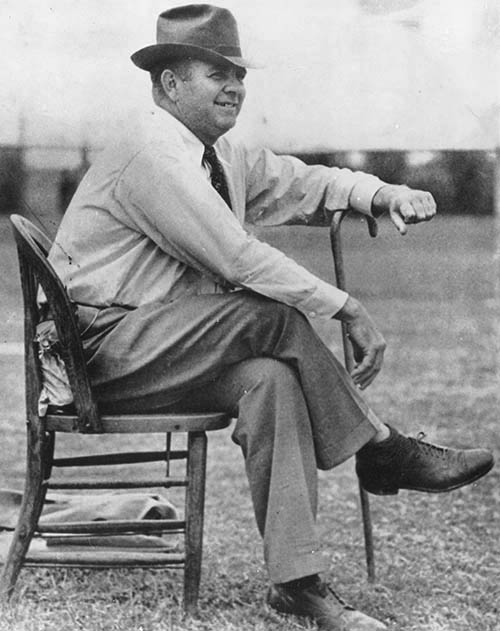
Bernie Moore
Sport: Coach
Induction Year: 1963
University: LSU
Induction Year: 1963
“You gotta be lucky to be a good coach,” Bernie Moore said. “It so happened that everywhere I went, I inherited a good bunch of boys.”
In the wake of his embarrassing locker room confrontation with “Biff” Jones in the final game of the LSU Tigers’ 1934 football season, Huey Long wanted to silence critics by bringing one of the best-known names in college football to Baton Rouge. He contracted Clark Shaughnessy, then at the University of Chicago, and arranged a meeting with Frank Thomas when his Alabama team stopped in New Orleans on its way to the Rose Bowl.
While Thomas was in California with the Alabama team, however, an LSU assistant coach was receiving strong support for the position.
Moore, who had led the Tigers’ track and field team to the national championship in 1933, was the choice of LSU Athletic Director T.P. “Skipper” Heard. He also received a public endorsement in the Baton Rouge Morning Advocate, and Long raised no objections after talking to Vanderbilt coach Dan McGugin about Moore.
The thinking was along the same lines that would be followed a half-century later, when Mike Archer was appointed to succeed Bill Arnsparger. Keep a winning staff together.
Moore was born in Jonesboro, Tenn., the youngest of 14 children of a Baptist missionary. He played football and baseball at Carson-Newman College in Jefferson City, Tenn., and organized a track team. Before he came to LSU, he had three years of experience as a head coach in college football – at Mercer University in Georgia.
His record there was 12 victories, 12 losses and two ties. Moore also coached (and taught English) at a high school in Winchester, Tenn., and a prep school in East Texas, and spent one year at Sewanee before joining Russ Cohen’s LSU staff in 1929.
As Archer would do later, Moore enjoyed immediate success thanks to the material he inherited from Jones. His first two teams won Southeastern Conference championships, and the Tigers made three consecutive appearances in the Sugar Bowl. But the Tigers lost all three bowl games, and did not score a touchdown in two of them. In Moore’s remaining 10 years at LSU, only two of his teams earned bowl bids.
Moore had played a key role in developing much of the talent he inherited, because he coached the 1933 freshmen – a bumper crop that included two-time All-American end Gaynell Tinsley, all-conference guard Wardell Leisk, all-conference halfback Bill Crass, Haynesville’s Rock Reed, Minden passing whiz Pat Coffee, guard Marvin Baldwin and center Marvin “Moose” Stewart. Along with Abe Mickal, a member of the previous class, and Charles “Pinky” Rohm, who showed up one year later, it was a great group to go to war with; the Tigers were 27-5-2 in Moore’s first three seasons.
Moore, hailed in the Morning Advocate endorsement as a diplomat who would “Get along fine with all, from Kingfish to the lowest student manager,” never had to deal with the Long problem. Long was killed three weeks before his first game as the Tigers’ coach.
Legend has it that Moore took a five-man track and field team to Chicago for the 1933 National Collegiate Athletic Association championships and brought the team title back to Baton Rouge. Actually, he took 10 athletes to Chicago, making the trip in two automobiles because of “financial retrenchment.” But only five of the Tigers scored points.
“We will be lucky to place as high as fifth,” he said before he meet, “and I personally will be satisfied if our team gets as high as sixth.”
He considered Stanford the team to beat, but the California team was crippled by injuries and LSU – which was especially strong in the hurdles – got another break when Ohio State’s Jack Keller (considered “the greatest hurdler the world has ever known”) crashed into a hurdle in a preliminary heat and had to drop out of the meet.
The Tigers had world class athletes in hurdler Glenn “Slats” Hardin, who won both the 440-yard dash and 220-yard low hurdles, and weightman Jack Torrance, who broke the listed world record in the shot put and also took third place in the discus throw. But Al Moreau also scored in both hurdles events, and Buddy Blair took fourth in the javelin. (A Baton Rouge newspaper reported that Blair “hails from the vicinity of Shreveport,” but Sicily Island is closer to Baton Rouge than Shreveport.)
The points that put LSU over the top, providing a 58-54 margin over Southern California, were provided by pole vaulter Matt Gordy. He tied Southern Cal’s Bill Graber, the world record holder, for first place, as Gordy exceeded his previous best by nearly eight inches.
LSU athletes who didn’t score were Ted O’Neil, Pete Burge, John “Red” Lehmann, George Fisher and Johnny Sanders.
In the national interscholastic championships, also held at Chicago’s Soldier Field that week, a Cleveland sprinter indentified as “Jimmy Owens” was creating quite a stir. Later, after he equaled the world record of 9.4 seconds in the 100 and also won the long jump and 220 to lead his team to the title, they got his name right: Jesse Owens.
At the end of his coaching career at LSU, Moore switched to the T-formation and Y.A. Tittle led the Tigers to the Cotton Bowl. “When Tittle leaves, “he joked, “I’m going to leave.”
That’s exactly what happened. In February of 1948, he was selected commissioner of the Southeastern Conference.

Recent posts
-
Kathy Holloway earns ’26 Dave Dixon Louisiana Sports Leadership Award January 8, 2026

-
Gil LeBreton, John James Marshall are 2026 sports journalism inductees in LSHOF January 7, 2026

-
Third year of impactful LSHOF membership drive launches November 4, 2025


