
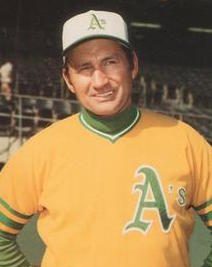
Alvin Dark
Sport: Baseball
Induction Year: 1976
University: LSU
Induction Year: 1976
Alvin Ralph Dark was an All-State and All-Southern tailback at Lake Charles High in 1940, and captain of the Wildcats’ basketball team. But baseball was his first love.
Lake Charles High didn’t participate in baseball at that time, but he played Legion ball for five years—and received a scholarship to Louisiana State University to play basketball and baseball.
Dark, who had already accepted a basketball scholarship to Texas A&M, decided to got out for football at LSU after he noticed that the menu at the football training table was considerably more attractive than the wiener, sauerkraut and thin slices of roast beef served to other athletes.
He lettered in all three sports, and led the Tigers’ football team to a 21-7 victory over Ole Miss (quarterbacked by Charlie Conerly) with touchdown runs of 70 and 46 yards. But his most vivid memories of that game were four punts—a 75-yarder and three coffin corner kicks that pinned the Rebels inside their two-yard line.
Before one punt, Dark asked the referee where the ball would be placed if he hit the flag.
“Right there,” he replied. “Right on the one-foot line.”
Dark proceeded to hit the flag—“one of those things,” he recalled later, “you couldn’t do again in two lifetimes of punting.”
“He’ll be a great back if he gets to play three years of conference ball,” LSU coach Bernie Moore said of the 19-year-old sophomore.
Because of World War II, Moore knew that was a very big “if.” Dark joined the Marine Corps’ V-12 program and was assigned to a unit at Southwestern Louisiana institute in Lafayette. With the V-12 unit attracting several future National Football League standouts in addition to Dark, SLI posted its first unbeaten season since 1906 and was seriously considered for both the Orange Bowl and Sugar Bowl.
Most small colleges dropped football in 1943 because of the war, but SLI defeated Southwestern (Texas) 27-6 and played Arkansas A&M to a 20-20 tie. Its other games were with service teams, including a 6-0 victory over Randolph Field—a team led by former Tulsa star Glenn Dobbs which tied Southwest Conference champs Texas 7-7 in the Cotton Bowl.
When the other major bowls opted for “name” teams (LSU, with three losses, won the Orange Bowl) SLI had to settle for a 24-7 victory over Arkansas A&M in a Dec. 1, Oil Bowl rematch at Houston.
Colonel Earl “Red” Blaik invited Dark to join the powerhouse he was assembling at West Point, but Alvin—who had dreamed of playing big league baseball since he was in elementary school—didn’t want to make a four-year commitment to the Army after two years at West Point.
The Philadelphia Eagles drafted him as a future choice, but Dark had no interest in pro football. Ted McGrew, a Boston Braves scout, was waiting for him in Lake Charles after the war. When McGrew asked Dark to write the amount he wanted on a piece of paper, Alvin put down $50,000—expecting it to open a bargaining session in which he’d happily settle for half as much.
McGrew looked at the paper and said, “You got it.”
After playing 15 games with the Braves at the end of the 1946 season, Dark spent the 1947 season with Milwaukee in the American Association. He hit .303 and won “Rookie of the Year” honors.
One year later, Dark was in the big leagues—hitting .322 and winning “Rookie of the Year” honors for manager Billy Southworth’s Boston Braves to lead the club to its first National League pennant since 1914.
He was traded to the New York Giants in 1950, and led the National League in doubles with 41 when the 1951 team erased a 13 ½ game deficit to beat the Dodgers in a playoff game. It was Dark, swinging on an 0-2 pitch by Don Newcombe, who got the scratch single that started the ninth inning rally climaxed by Bobby Thomson’s dramatic homerun.
Neither the 1948 Braves nor the 1951 Giants won the World Series, but the third time was the charm for Dark when the 1954 Giants beat the favored Dodgers by five games and then swept the Cleveland Indians in the World Series.
Dark made two more World Series appearances as a manger, with the San Francisco Giants in 1962 and the Oakland A’s in 1974. The Giants won the first two games, but lost to the Yankees in a seven-game series. The A’s, united by their hatred of owner Charlie O. Finley, took their third straight world title in a five-game series with the Dodgers.
He led the A’s to another Division title in 1975 before Finley fired him after a playoff loss to the Boston Red Sox.
That wasn’t first time Finley fired Dark. In 1967, when the A’s were located in Kansas City (and in tenth place in American League standings), Finley fired Dark twice in a span of 11 hours—offering him a two year contract with a raise between firings.
The first firing was over the handling of a situation involving Lew Krausse, a young pitcher accused of “rowdysim” on a team flight. Relieved that his relationship with the overbearing Finley was over, Dark relaxed and told the owner his club had a great future and could be pennant contenders by 1971. He was so convincing that Finley offered him his job back, with a raise. But a petition signed by the players, supporting Dark against the owner, threw a monkey wrench into the deal. “I will never forget the way they have stood up for me,” a tearful Dark said leaving.
As a player, Dark had a .289 batting average in a 14-year major league career.
As both a player and manager, he received as much recognition for his Christian beliefs—tithing his income since he made $5.42 for two weeks of delivering newsopapers in Lake Charles—as he did for his performances. Finley repeatedly ordered him to “lay off the Bible,” but Dark was more likely to quote scripture than batting averages in press conferences.

Recent posts
-
Louisiana Sports Hall of Fame announces star-studded 2027 induction class September 9, 2026

-
Hall of Famer Jerry Stovall passes away at age 85 August 31, 2026

-
Passing of a legend: LSU’s transformational Skip Bertman dies at 88 August 14, 2026


