
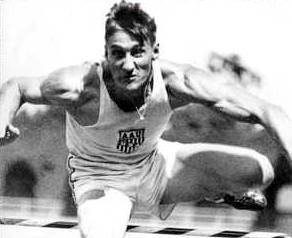
Al Moreau
Sport: Track and Field
Induction Year: 1963
University: LSU
Induction Year: 1963
Al Moreau didn’t have an athletic scholarship when he went to Louisiana State University in 1929.
Moreau, who grew up on his father’s farm and was a four-sport athlete at Marksville High, worked his way through school by pruning shrubs, sweeping out barns and tending milk cows in the campus dairy.
Somehow, he found time to participate in track and field – winning a Southern Intercollegiate Athletic Conference championship in the 120-yard high hurdles as a sophomore and lowering the conference record to 14.9 seconds the following year.
That set the stage for his senior year, 1933, when Moreau was captain of an LSU team that made track and field history by becoming the first Southern team to win a National Collegiate Athletic Association championship.
Before the NCAA meet at Chicago’s Soldier Field, Moreau set a record of 14.56 seconds in the first Southeastern Conference track and field championships at Birmingham.
In the same meet, Glenn “Slats” Hardin o LSU won the 220-yard low hurdles and Moreau finished third.
Coach Bernie Moore took 10 athletes to the national meet. Three of them – Hardin, Moreau and weightman Jack Torrance – scored in two events apiece. Matt Gordy tied for first in the pole vault and Nathan “Buddy” Blair took fourth place in the javelin throw as the Tigers scored a stunning upset victory to capture the team title with 58 points to 54 for runner-up Southern Cal.
Moreau was runner-up to Stanford’s Gus Meier in the high hurdles, and took sixth place in the 220-yard low hurdles as Hardin lowered the world record to 22.9 seconds.
The Tigers stayed in Chicago for the national AAU meet the following week, with Moreau taking third place in the high hurdles as another Louisiana athlete – Johnny Morriss of Southwestern Louisiana Institute – lowered the world record to 14.3 seconds in a qualifying heat. Stanford’s Meier was fourth in the AAU meet.
Two years later, touring Europe with a United States track team, Moreau equaled the world record of 14.2 seconds in the high hurdles. On the same tour, he became the first man to break 14 seconds with a 13.9 clocking – but that was such a mind-boggling performance that meet officials refused to certify it.
In retrospect, Moreau must have been one of the finest technicians of all time. He set those records despite the fact that his foot speed wasn’t extraordinary. He never ran the 100-yard dash faster than 10.3.
Moreau never qualified for an Olympic team. An injury during the 1936 Olympic trials at Princeton, N.J., cut short his career. He was leading the field in the final race until he hit a hurdle – they were made of sturdy stuff in those days – and suffered a leg injury that ended his hurdling career.
By that time, Moreau had put his agriculture degree to work by serving as an assistant parish agent in St. Landry, Assumption and Lafourche parishes. He returned to LSU as an assistant horticulturist in the university’s agricultural extension service from 1941 to 1943.
When LSU was looking for a successor to Moore in 1948, Moreau was asked to return to his alma mater as track and field coach. He agreed, under one condition – that he could continue his agriculture work. He was appointed track coach and assistant horticulturist in the ag extension service.
After his first two LSU teams finished second in conference meets, Moreau was checking out a prospect in the 100-yard dash in an intramural meet a couple of week before the 1951 SEC meet. His high-regarded prospect, wearing track shoes, was impressive – but a country boy from Vidalia who was running in his stocking feet five yards ahead of him (and everybody else).
After the meet, Moreau introduced himself to Charlie Johnson. A couple of weeks later, Johnson finished fourth in the 100 and third in the broad jump (now long jump) in the SEC meet at Birmingham, leaping over 23-9 in the latter event – less than three inches behind the winner. LSU won the championship.
The Tigers didn’t win the team title the following year, but Johnson tied Billy Brown’s school record of 9.5 in the 100 and took individual scoring honors in the SEC meet by winning the 100 and broad jump, and taking second place in the 220.
Moreau guided LSU to six conference titles, and was voted Coach of the Year in the Southeast Region of the United States in 1958. His teams also won the SEC indoor titles in 1957 and 1963. He served on the SEC track committee, Southern AAU track committee, and NCAA board of directors, and served one term as president of the NCAA track coaches.
Moreau met Lilla May Heck, his future wife, at LSU, and they raised a family of nine children – three boys and six girls.
One of his sons, Doug Moreau, was an All-Southeastern Conference end on the 1964 LSU football team, catching a two-point conversion pass from Billy Ezell that gave the Tigers an 11-10 victory over Ole Miss. Moreau, who has been an analyst for “Voice of the Tigers” Jim Hawthorne in recent years, finished his career in second place in career receiving behind All-American Ken Kavanaugh. He also did the place kicking, setting a school scoring record of 165 points.
Al Moreau died July 7, 1990, following a bout with cancer. A week later, LSU established the Al Moreau Memorial Scholarship in memory of the gentleman farmer from Marksville who made his mark at the Ole War Skule as an athlete and coach.
“When you think of LSU track and field,” said Tom Douple, who had worked with Moreau in a fund-raising project to support the Tigers’ track program the previous year, “you think of Al Moreau. He was an athlete, coach and later track and field official. So it is only fitting that this scholarship be named in his honor. He gave so much to the sport at LSU, and this is a small way to honor him for his efforts.”

Recent posts
-
Louisiana Sports Hall of Fame announces star-studded 2027 induction class September 9, 2026

-
Hall of Famer Jerry Stovall passes away at age 85 August 31, 2026

-
Passing of a legend: LSU’s transformational Skip Bertman dies at 88 August 14, 2026


