
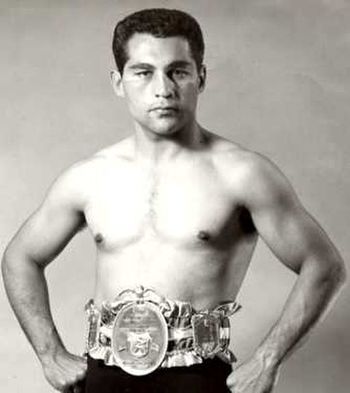
Willie Pastrano
Sport: Boxing
Induction Year: 1965
Induction Year: 1965
Willie Pastrano was a fat kid growing up in New Orleans. Neighborhood bullies teased him, saying he was like jello shaking on a plate. Willie’s dad whipped him with a belt because he wouldn’t fight back when they taunted him. So Willie went to a boxing gym to lose weight.
On June 1, 1963, Pastrano went to the Las Vegas Convention Center and became the light heavyweight boxing champion of the world.
Later, after he lost the title to Jose Torres in 1965, Pastrano became a heroin addict.
Pastrano made $100,000 in his last fight. A year later he was robbing houses and yachts, “sneaking in like a dog” to support his habit.
He went cold turkey in 1969. When Sugar Ray Leonard and Roberto Duran went to New Orleans for their 1980 rematch in the Louisiana Superdome, they were paid a total of $17 million for the “no mas” fight in which Duran presented a gift-wrapped title to Leonard. Pastrano, who was working as the boxing coach of the New Orleans Recreation Department, cleared $69.50 that week.
On his way to the top, Pastrano once sat at tea with the Queen of England and Prince Phillip. On his way down, he opened his doors to killer and dope dealers, including one guy who sawed up human bodies for his disposal.
“I was the living dead,” Pastrano said.
He won the light heavyweight title by outpointing Harold Johnson, although Johnson was the aggressor throughout the 15-round bout.
Moving ever backwards, sometimes in circles and sometimes gliding from side to side, Pastrano stuck enough jabs along the way to capture a split decision.
Judge Harry Krause gave Pastrano the nod, 69-67. Judge John Romero’s vote went to Johnson, 69-68. The third man in the ring, referee Jim Olivas, scored it 69-68 for Pastrano.
Other ringside observers favored Johnson by as much as eight points.
“We were robbed,” said Johnson’s manager, Pat Olivieri. “How could they give it to him? He ran all the way.”
Barney Nagler, covering the fight for the New York Morning Telegraph, agreed. “It was an outrage,” he said.
Traditionally, the champion doesn’t lose a close decision. But this was the exception to that rule. At the age of 28, Pastrano won the nationally televised fight with jabs that popped Johnson like a wet sponge. It was his 59th victory in 78 fights.
Twice, Johnson was cautioned for low punches. But the only time Pastrano landed a solid fight to the champion’s jaw was in the 12th round. In the last three rounds, Johnson seemed to be stronger. But many of his best shots were thrown from too far away. By the time they landed, they had lost their power. By the 15th round, neither boxer was able to land an effective punch.
The $60,000 paid by television took care of the guarantees — $37,000 to Johnson, $21,250 to Pastrano. The live crowd was only 3,200, making the event neither a financial nor an artistic success.
Archie Moore was the light heavyweight champion from 1952 to 1961. But Moore was stripped of his National Boxing Association title by official decree, and lost interest in the World Boxing Association championship by 1962 – when Johnson nailed down his title claim with a 15-round decision over Doug Jones.
Pastrano, who was inducted into the Louisiana Sports Hall of Fame in 1974, lost his title the third time he defended it when Torres scored a ninth-round knockout. It was only the second time in his pro career that Willie didn’t get up.
“When I lost the title,” he said, “I got down on myself. I was lonely. I had nobody. It wasn’t the heroin I wanted. It was the boxing thing. I didn’t know who the hell I was.”
Pastrano said kicking the heroin habit was his toughest fight, without question. “You never really kick it,” he said. “You always got the yen. You always got to fight.”
In the ring, slugging it out was never Willie’s style. He was a dancer, a stick-and-move guy. But he had to go toe-to-toe against heroin. “I’m the champ at fighting the junk,” he said.
He went to churches to tell people the junk put him in three mental institutions and three hospitals. But most of the time, it was like addressing a gathering of aliens from another planet.
“I look at ordinary people in their suits, then with no scars on their faces, and I’m different from these people,” said Pastrano. “I don’t fit in with them people. I’m where everybody’s got scar tissue on their eyes and got noses like addles. Boxing is what I am.”
He didn’t waste time wallowing in self-pity. “I’ve had money,” he said. “I’ve been rich.”
Three years of heroin abuse couldn’t take away his golden memories.
During one of his workouts for the 1980 fight, Duran looked into the crowd and raised his gloved fist in a salute.
“I looked around to see who he was waving to,” Pastrano said with a pride of a champion. “It was for me.”

Recent posts
-
Legendary LSU basketball coach Dale Brown dies at 90 October 23, 2026

-
Louisiana Sports Hall of Fame announces star-studded 2027 induction class September 9, 2026

-
Hall of Famer Jerry Stovall passes away at age 85 August 31, 2026


