
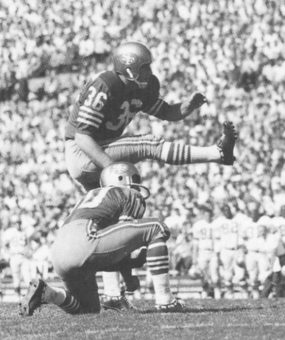
Tommy Davis
Sport: Football
Induction Year: 1988
University: LSU
Induction Year: 1988
The reason LSU won the national football championship in 1958 and did not win it in 1959 can be summed up in two words.
Tommy Davis.
Davis passed up his final year of eligibility to sign a professional contract with the San Francisco 49ers. In the 1958 championship season, his placekicks provided the winning margin in two games (10-7 over Florida and 7-6 over Mississippi State), and his booming punts assured great field position for the Tigers throughout the season—an essential ingredient in Paul Dietzel’s conservative style of play.
LSU’s only loss in regular-season play the following year was a 14-13 decision to Tennessee at Knoxville in which Wendell Harris missed a field goal attempt from the Vols’ 12 yard-line. That kick would’ve been a piece of cake for Davis, who still holds the National Football League record for 234 consecutive extra points.
At that time, bowl games were not included in final wire service polls. Of course, if LSU had been ranked No. 1, Dietzel would’ve never given Ole Miss a rematch in the Sugar Bowl.
In addition to his NFL record four consecutive extra points, Davis ‘ lifetime punting average of 44.7 yards is second in pro football history to Sammy Baugh’s 45.1. Baugh, a great passer, had the advantage of getting long rolls on many third down punts—when opposing defenses couldn’t take a chance on him throwing the ball instead of kicking it.
In the final regular-season game of LSU’s championship season in 1958, Davis stood on the goal line in the Sugar Bowl and turned the field around with a punt that landed at the Tulane 15 yard-line. LSU led that game 6-0 at halftime, but an avalanche of touchdowns in the second half turned it into a 62-0 rout.
When coaches F. H. Prendergast and Roy Wilson selected an all-time Fair Park High School team in 1952, they picked only one member of the Indians’ only state championship team—Tommy Davis.
He is best remembered for his kicking exploits, but Davis was a great fullback and linebacker on Fair Park teams that reached the state finals three years in a row.
In 1952, the only other returning starters were tackles Harley Brown and Kenneth Fountain. Fair Park wasn’t favored to repeat as district champion. But Davis broke the sate scoring record with 184 points in regular-season play and set a Shreveport-Bossier City record with 1,650 yards rushing. His linebacking was one of the main reasons the Indians won their last three games—including playoffs at Sulphur and St. Aloysius—by a combined score of 61-0.
Ironically, Fair Park ‘s only loss that year was the result of a play on which Davis should’ve punted the ball.
Istrouma of Baton Rouge, which had defeated Fair Park two years in a row in state championship games, was the opponent in a fierce defensive struggle. Davis staged what Istrouma coach James “Big Fuzzy” Brown later called the greatest punting exhibition he ever witnessed at any level of football. But after Fair Park stopped a 75-yard Istrouma drive at its two yard-line in the last two minutes, a fake punt that was changed from a pass to a run backfired as Istrouma linenbacker Ronnie Riley tackled Davis in the end zone to give Brown’s team a 2-0 victory.
The bittersweet irony of Davis ‘ 1987 induction into the Louisiana Sports Hall of Fame is that it came one year too late for him to enjoy it. The previous summer, he learned that he had lung cancer. He made a final trip to Shreveport in October of 1986 to spend some time with family and friends. He called Rogers Hampton, a teammate on the 1950 and 1951 Fair Park football teams, “the greatest athlete who ever walked the streets of Shreveport .”
“You can never go back”, Davis said. “It’s never the same.”
The following January, Davis was voted into the Hall of Fame. “Tell them I’m very pleased and very honored,” he told his wife, Ita.
“He’s very weak,” she added. ‘I doubt very much that he’ll be able to be there for the induction…unless a miracle happens.”
A few days earlier, when Larry Csonka was voted into the pro football Hall of Fame, Csonka said it was “like living forever.” But Davis, who didn’t miss a point in nine NFL seasons because he was able to concentrate on the task at hand, knew the difference between the toy department of sports and the real world.
He died on April 2, 1987, two months before his induction.

Recent posts
-
Legendary LSU basketball coach Dale Brown dies at 90 October 23, 2026

-
Louisiana Sports Hall of Fame announces star-studded 2027 induction class September 9, 2026

-
Hall of Famer Jerry Stovall passes away at age 85 August 31, 2026


