
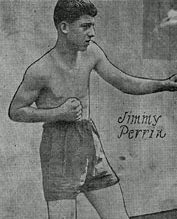
Jimmy Perrin
Sport: Boxing
Induction Year: 1965
Induction Year: 1965
In the 1954 movie “On the Waterfront,” Marlon Brando said, “I coulda been a contender.”
Jimmy Perrin was a contender in 1940, when Ring Magazine ranked him No. 5 in the featherweight division. He coulda been the champ. But the National Boxing Association never game him a shot at the title.
When Perrin’s manager, Sam Weaver, sent a telegram to the NBA asking the group to consider Perrin a foremost challenger to featherweight champion Joey Archibald, they said he would have to fight Harry Jeffra first.
Then Perrin got a fight with Archibald at New Orleans’ Municipal Auditorium. But the title wasn’t on the line.
“You can’t get around the fact that our James fights best against top opponents,” Emile Bruneau said on the eve of the Perrin-Archibald fight.
“We’ve been trying to get a shot at Archibald for, lo, these many months,” Bruneau said. “We wanted a title crack, of course, but couldn’t get it. But watch our James roll Monday night.”
Perrin didn’t exactly roll past Archibald on Feb. 26, 1940, but he rolled into the Louisiana Sports Hall of Fame 25 years later.
Perrin, whose real name was James Lavaca, was born Feb. 3, 1916, in New Orleans. Because of his curly hair and the fact that his mother sent him to Jose Corbera’s dancing school as a small boy, neighborhood kids called him a sissy. But Jimmy put the footwork he developed in the dancing school to use in boxing workouts after his dancing performances.
His mother was upset when she learned that her son was boxing, but finally gave her permission. Then she married Ernie Perrin, and he took charge of his stepson’s boxing career.
Jimmy Perrin turned pro in 1933, after making a bid for the 1932 Olympic team, and had his best year in 1939. He won 12 of 13 bouts. The only loss was to Chicago’s Leo Rodak, who had dropped a close 15-round decision to Archibald earlier in the year. Rodak called his victory over Perrin one of the toughest fights of his career.
When his 10-round bout with Archibald was announced, promoters said the championship would not be at stake in the Finnish Relief Fund event. The deal called for Perrin to come in at 127 pounds or more – over the featherweight limit. He weight in a half-pound over 127.
“I don’t know a thing about Perrin,” said Archibald, the first world champion from Rhode Island. “They tell me he is a good boy.”
On Feb. 26, 1940, Perrin finished strong. He won the last two rounds to take a split decision over the champion.
“The winner – and a big step toward national prominence – Jimmy Perrin,” declared the announcer.
The referee scored the fight 97-95 for Perrin. One judge had Perrin winning 96-87 and the other favored Archibald, 96-92.
Pete Baird, boxing writer for the New Orleans Times-Picayune, thought Archibald won seven rounds. He put it down as “a home town decision – but a very popular one.” The crowd of 5,500 spectators cheered the verdict.
“He’s a good boy,” acknowledged Archibald. “He’s awkward, and hard to fight.”
“He’s strong, fast and smart,” Perrin said of the champion.”He’s plenty fast, too – a great fighter, He stung me when he caught me going back against the ropes, but at no time did he hurt me. I had to let him come to me.”
There was talk of a rematch. Al Weill, Archibald’s manager, said the champion would fight anybody for $10,000. But Archibald, who won the title by outpointing Jeffra on Oct. 17, 1938, in New York, fought Jeffra again three months after his loss to Perrin – and lost a 15-round decision in Baltimore. A year later, Archibald regained the title and then lost it again.
Playing the “ifs and buts” game, Perrin would’ve had an excellent shot at the title. He had a reputation for great performances in rematches. Henry Hook and Frankie Corvalli scored knockout victories over Perrin, but he boxed their heads off in return bouts.
Perrin’s biggest victory in 1939 was over bantamweight champion Sixto Escobar. He also beat Corvelli, Everette Rightmire, Johnny Gaudes and Darse Robertson. His final fight of the year was a decision over Sammy Musco in Birmingham.
Earlier, Perrin beat Chicago’s Eddie Lander twice in two weeks.
Lander and his manager, Danny Spunt, thought they got a bum decision in the first fight. “There’ll be no doubt about it this time,” Spunt predicted before the return bout.
Perrin won again, but it was close and the decision was boxed by many in the crowd of 3,700 at Municipal Auditorium. The New Orleans boxer seemed to be enjoying himself, laughing during a couple of late flurries of left hooks.
“It was an easier fight this time,” Perrin said. “This time I was boxing better, and I think I won easier.”
His victory in balloting for the Louisiana Sports Hall of Fame in 1965 was much easier. With 39 sports writers casting votes, Perrin led the way with 23 – nearly doubling everybody else. Long-time Louisiana Normal and Northwestern State basketball coach H. Lee Prather and former Brooklyn Dodger pitcher Ed Head had 12 and 11, respectively.
Perrin, a retired New Orleans policeman who was a public relations man for an amusement company in 1965, was fearless in the ring. But when he stepped to the podium at a packed Shreveport Country Club to acknowledge his induction into the Hall of Fame, it was a different story.
The man who fought the best in his weight division and was afraid of nothing admitted he was just plain scared behind the microphone. But after a shaky start, he regrouped and finished strong – just as he did on Feb. 26, 1940.
There were no boos from the country club crowd. The man who coulda been the champ, but never got his shot at the title, received a standing ovation.

Recent posts


