
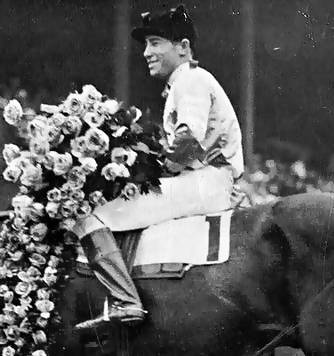
J.D. Mooney
Sport: Horse Racing
Induction Year: 1976
Induction Year: 1976
No four-legged animal is in the Louisiana Sports Hall of Fame, but John David Mooney rode into the hall on the back of legendary Black Gold.
Mooney, the son of a riverboat captain, grew up in New Orleans with the dream of becoming a jockey at the Fair Grounds race track. He became a principal character in one of the great horse racing legends of all time.
It started in 1909, when Al Hoots – an Irishman living with the Osage Indians in Oklahoma – paid 80 acres of land for a filly named Useeit, sired by Bonnie Joe – the greatest sire of short distance horses in the West.
Useeit won 34 races at county fairs and bush tracks in Oklahoma and Mexico. Hoots shipped his filly to tracks as far away as New Orleans, Canada and Mexico, and Useeit beat all rivals except Pan Zaretta.
Hoots entered Useeit in a claiming race in Juarez, Mexico, with a “gentleman’s agreement” that nobody would claim his filly. But the agreement wasn’t honored, and a man produced the $1,500 claiming price. Hoots excused himself a few moments and returned brandishing a shotgun. That settled the dispute, but Hoots and Useeit were both banned from racing, and the filly’s name was stricken from the thoroughbred registry.
Two years later, oil – black gold – was discovered on Hoots’ property, and he suddenly became a wealthy man. He decided to breed his beloved little mare to the best stallion in Kentucky, Colonel E.R. Bradley’s Black Toney.
This was the 1920s, and every great sports story had a deathbed scene – or at least a visit to a kid in a hospital. Hoots’ health was failing him before his mare foaled. On his deathbed he told his wife, Rosa, of a vision that the foal would race in the Kentucky Derby. He asked her to name the offspring Black Gold, and enter the colt in the Kentucky Derby. “If you will promise to do this for me,” he said, “I will die a happy man.”
After his death, Useeit’s name was restored to the thoroughbred registry – probably due to the influence of Col. Bradley – and her foal, Black Gold, won nine of 18 races as a two-year-old. The following year, Black Gold was four-for-four (including a victory in the Louisiana Derby) going into the Kentucky Derby, and was favored by bettors at Churchill Downs.
Trainers, clockers and others in the bluegrass racing establishment had doubts about the little colt’s staying power and training, and questioned the savvy of J.D. Mooney, the young jockey, in the 50th Run for the Roses.
The trainer was Harry Webb, an Osage Indian who had looked after the colt since Black Gold was a weanling. He campaigned Black Gold had as a two-year-old, while other Derby candidates were enjoying a life of leisure on their farms. In New Orleans, there were reports that he left the colt out in the rain and sleet without a blanket. When it was time to ship North, he chose a slow freight.
Other trainers considered his tactics suicidal, but Webb knew what he was doing. He wanted the colt to move northward as slowly as possible to avoid a sudden change in temperature.
The proof of a race horse is in the racing, and on May 17, 1924, Black Gold removed all doubts – charging past Chilhowee and Beau Butler, the entry from Col. Bradley’s Idle Hour farm, to take the winner’s purse of $52,775 before the largest crowd (estimated at 80,000) ever to watch a Kentucky Derby at that time.
When Rosa Hoots went to the presentation stand to accept the $5,000 gold emblematic of winning the Kentucky Derby, observers said she was calm and poised – with the manner of a woman who seemed to know she was destined to be there.
The Black Gold legend had a tragic ending four years later. The champion was retired to stud, but his performance as a stallion was not satisfactory and Black Gold was brought out of retirement in 1927 to attempt a comeback despite misgivings about his soundness.
At the Fair Grounds in New Orleans, where Black Gold had scored his first victory in the first race of the Jan. 8, 1923, program, the doubts were proven to be correct on Jan. 18, 1928. Competing with eight other horses in the Salome Handicap, which was the No. 2 event on the program, Black Gold ran a strong race but broke his left foreleg with a sixteenth of a mile to go. His finished the race on three legs, but was destroyed after an examination of the injury.
The great champion, shaking his proud head in resentment of the tight hold on him, flinched as the needle pricked his skin, then tossed his high head and pricked eras as it was withdrawn. A second later, he dropped dead.
When spectators learned of the tragedy, many of them rushed to the paddock to claim a lock of hair from his mane or tail as a souvenir.
Winning 18 of his 35 starts and finishing in the money nine other times, Black Gold had career earnings of $110,503. He was insured for $45,000.
The day after his death, Black Gold was buried in the infield of the Fair Grounds beside the grave of Pan Zaretta, the filly that had defeated Useeit.
Mooney also won the Louisiana Derby on Amole in 1923, and had a 10-year total of 261 victories in his riding career. But many Louisiana jockeys have surpassed those numbers and only one of them, Eric Geurin, is in the Louisiana Sports Hall of Fame. The reason none of the other made it is that none of them ever rode Black Gold.
Each year, the Black Gold stakes was held at the New Orleans Fair Grounds in honor of the legendary champion, with the winning jockey placing a wreath of flowers on the monument with the smooth curving saddle marking Black Gold’s grave. Before his death in 1966, Mooney often returned to the track to accept the wreath from the winning jockey and walk to the centerfield to decorate the grave while spectators rose in silent tribute.

Recent posts


