
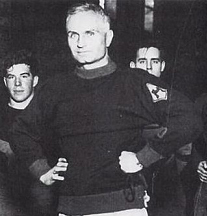
Bernie Bierman
Sport: Coach
Induction Year: 1967
University: Tulane
Induction Year: 1967
In Bernie Bierman’s first season as head football coach at Tulane University, the 1927 Green Wave defeated Mississippi 19-7 in the opening game and beat LSU 13-6 in the final. The six games between those bookends consisted of five losses and a tie with Auburn.
In his last three seasons at Tulane, Bierman’s Green rolled to 28 victories in 29 regular-season games—a record marred only by a loss to Northwestern in 1930.
Like Knute Rockne, the foremost coach of his era, Bierman was the son of European immigrants. But the only other similarity was the success of their teams. While Rockne was a public relations genius known for his locker room oratory, Bierman avoided the spotlight and was a man of few words.
“I don’t think I’d be able to make a sentimental dressing room talk,” he said. “I’m afraid I would end up laughing at myself.”
One of the most famous halftime speeches consisted of three words With Tulane trailing Georgia 15-14 in a 1929 game, assistant coach Lester Lautenschlaeger chewed out the Greenies during the intermission. He concluded his remarks by throwing his hat on the floor, stomping on it and shouting, “Georgia! I can lick the whole state of Georgia by myself!”
Bierman then stepped forward, driving his own heel into the crumpled hat, and added, “So can I.” (Tulane won, 21-15.)
Another halftime speech consisted of five words.
When his Minnesota Gophers were trailing Pittsburgh 7-0 at halftime, Bierman said, “Two touchdowns will win it.”
In a game that eventually decided the national championship, Minnesota rallied to score a 13-7 victory.
That was the first of Bierman’s four national titles at Minnesota.
When his last Tulane team ran onto the field for a game with favored Vanderbilt, Bierman called his players back into the locker room. “Walk—don’t run—onto that field,” he told them. “Do your warming up out there, not on the way. Keep your brains quiet. Your legs will take care of themselves.”
His Tulane teams won three Southern titles and were 4-0-1 against both LSU and Auburn. In his last three seasons at the New Orleans school, the Green Wave was 3-0 against both Georgia and Georgia Tech. Mississippi State, which Bierman coached for two years before taking the Tulane job, beat his Green Wave team and then was humiliated by margins of 45, 34, 53 and 52 points. All of his last three Tulane teams defeated Texas A&M.
Bierman’s unbeaten 1929 Tulane team consisted of only 28 players. In his final game as the Green Wave coach, nine players went the full 60 minutes in the Rose Bowl loss to Southern Cal.
Suffering from osteomyelitis as a youngster, Bernard William Bierman spent much of his time indoors or on crutches. Three operations corrected the problem, and he starred in three sports at Litchfield, Minn., High School. But when he fell on his face on a frozen football field and chipped two teeth as a 16-year-old halfback, he was afraid his parents would be so angry over the dental bill that they would forbid him to play any more football.
At the University of Minnesota, he won seven varsity letters—three apiece in football and track, on in basketball—and was presented a Big Ten medal for proficiency in scholarship and athletics. He captained the football team in 1915, and ran the 100 yard dash in 10 seconds flat and the 220 in 22.5 the following spring.
His first coaching assignment was a Butte Montana, High School, and produced a perfect season. Then Bierman enlisted in the Marine Corps for World War I, and was a captain when the war ended. After coaching at the University of Montana for three years, he dropped out of coaching to sell bonds. But he couldn’t stay out. He returned as an assistant to Clark Shaughnessy at Tulane, and then moved to Mississippi State as head coach. His second Mississippi State team upset Tulane 14-0, and when Shaughnessy moved to Loyola in 1927 Tulane quickly hired Bierman.
He served another stint in th eMrines in World War II, and turned down an offer from Southern California afer the war because he felt he could rebuild the Minnesota program. But the Golden Gopher’s’ talent had dwindled during the war. Bierman’s teams won more games than they lost from 1945 to 1950, but they couldn’t equal the standards established by his powerhouses in the 1930s. The coach who led Minnesota to four national titles was hanged in effigy, and “Bye, Bye, Bernie” signs appeared.
Bud Wilkinson, who played for Bierman at Minnesota and was then leading Oklahoma to 47 straight victories, recalled something his father told him when he took the Oklahoma job.
“No matter how successful he may be,” said the elder Wilkinson,” said the elder Wilkinson, “every coach eventually reaches a point where a lot of people want somebody else.”
Taking time out for global wars twice, Bierman’s 26-year record at four schools was 147 victories, 60 losses and 12 ties—a winning percentage of .699.

Recent posts
-
Louisiana Sports Hall of Fame announces star-studded 2027 induction class September 9, 2026

-
Hall of Famer Jerry Stovall passes away at age 85 August 31, 2026

-
Passing of a legend: LSU’s transformational Skip Bertman dies at 88 August 14, 2026


