
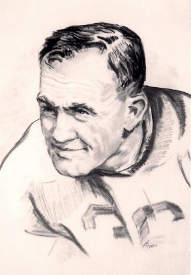
Robert "Cal" Hubbard
Sport: Football
Induction Year: 1966
University: Centenary
Induction Year: 1966
A 225-pound lineman at Centenary College from 1922-24, Robert “Cal” Hubbard was the school’s first All-American. In his first collegiate game, Hubbard returned a kickoff for a touchdown, but his greatest game was in an upset against Maj. Frank Kavanaugh’s Boston College team. Hubbard left Centenary to accompany Coach Bo McMillin to Geneva College. He later became an all-time great professional player with the Green Bay Packers and New York Giants. Hubbard later spent 10 years as a Major League Baseball impire. He is the only person enshrined in both the Pro Football Hall of Fame and the National Baseball Hall of Fame.
There are 159 men in the Football Hall of Fame at Canton, Ohio, and nearly 200 men in the Baseball Hall of Fame at Cooperstown, N.Y.
One man, Robert “Cal” Hubbard, is in both of them—and the Louisiana Sports Hall of Fame at Natchitoches, La.
Robert Calvin Hubbard made the Football Hall of Fame as a lineman, considered the best in the first half century of the National Football League by such authorities as George Halas and Jimmy Conzelman.
He made the Baseball Hall of Fame as an umpire—a profession that overlapped his football career.
He is the Louisiana Sports Hall of Fame because Bo McMillin took the football coaching job at Centenary College in 1922, and Hubbard was determined to play football for McMillin.
After the 1921 season, the biggest name in college football was McMillin, quarterback of the “Praying Colonels” of little Centre College in Danville, Ky. McMillin’s 31-yard touchdown run gave Centre a 6-0 victory over Harvard in a classic David-Goliath match-up.
That game, Harvard’s first loss in five years, was cited by a generation of coaches, teachers and ministers as proof that a small band of dedicated, motivated people (the 16-player Centre squad earned its nickname by praying before each game) could overcome the greatest obstacles.
Before McMillin left Centre College to take the Centenary job, he took his track and field team to Columbia, Mo., for a dual meet.
In the hotel lobby, a 6-3, 225-pound youngster walked up to McMillin and extended his right hand.
“I’m Cal Hubbard” he said. “What’s that place you’re going to coach next fall?”
“Centenary College,” said McMillin.
“Never heard of it,” the youngster said. “But it doesn’t matter. I’m going wherever you’re going. I want to play football for you. So does my friend.”
Then he introduced Glenn Latteer, who ran the 100-yard dash in 10 seconds flat. The following day, they saw Bard “Mexico” Farrell, who was over six feet tall and weighed more than 200 pounds, run the 100 in 9.8 and win three other events (shot put, long jump, low hurdles) in a high school meet. When Farrell assured McMillin that he was equally talented in football, the coach asked the persuasive Hubbard to bring Farrell to Shreveport, too.
The group, called “Bo’s Pros” by some skeptics, had a 26-3 record in the next three Centenary seasons—highlighted by a 10-9 upset victory over Boston College.
Hubbard was born on a farm in Keytesville, Missouri, halfway between St. Louis and Kansas City, on Oct. 31, 1900. After graduating from high school, he attended Chillicothe Business College—and worshiped McMillin from afar, reading about his exploits in newspapers.
At Centenary, Hubbard made it clear that McMillin’s word would be law—and he was willing to enforce it if necessary. At the first team meeting, McMillin insisted on no smoking, no drinking and no card playing.
“Not even an occasional cigarette?” asked Hubbard.
“No,” replied McMillin.
So the giant tackle threw his pack of cigarettes across the room. “I’m through with smoking,” he announced, “and if I catch anyone else smoking, I’ll beat him to a pulp.”
When he caught one teammate violating the rule, Hubbard took off his belt and gave him a woodshed-style strapping.
When McMillin left Centenary three years later, Hubbard followed him to Geneva College in Pennsylvania. By that time, he was a 250-pounder who was strong enough to toss opponents out of his path with a sweep of one arm. At times, he flattened an entire line with his defensive charge. Walter Camp selected Hubbard on his All-American team in his final season at Centenary, and Grantland Rice named him on his All-American team in his final season at Geneva.
While McMillin and Hubbard were successful on the playing field, eligibility questions played a role in their departure from Shreveport. Centenary was seeking accreditation by the Southern Association of Colleges and Secondary Schools, and the association expressed concerns about Centenary’s over-emphasis on athletic in general and the practice of outsiders—some of whom might be gamblers—paying the coach’s salary. Hubbard had earned only 32 credits in three years at Centenary, and professors complained about football players missing classes when they took long trips.
In 1927, Hubbard signed a contract to play football with the New York Giants for what was then a staggering salary of $150 per game. He was a three-time All-Pro with the Giants and Packers, and would’ve made it seven times if All-Pro teams had been selected in his first four seasons.
As early as 1928, Hubbard was umpiring baseball games between football seasons. By 1933, the big guy was calling balls and strikes in the big leagues—while he was playing in the NFL. Hubbard, who once played an entire pro game with a broken foot, decided to drop football, but Giants coach Steve Owen lured him back for a game with the Lions. “I won’t use you unless there is an emergency,” Owen promised.
The “emergency” turned out to be 55 minutes of playing time—plus a post-game free-for-all.
With one minute remaining in the final game of the season, against the Redskins, Hubbard stood up at the line of scrimmage and announced his retirement. ‘If any of you guys have a grudge against me,” he told the Redskins, “you have one minute to get it out of your systems. I’m retiring.”
There were no takers.
“My whole life has been wrapped up in sports,” he said at the end of his umpiring career, “and I don’t have one damn minute of regret.”
Red Grange called Hubbard “the greatest tackle I ever played against—or got clobbered by.”

Recent posts
-
Louisiana Sports Hall of Fame announces star-studded 2027 induction class September 9, 2026

-
Hall of Famer Jerry Stovall passes away at age 85 August 31, 2026

-
Passing of a legend: LSU’s transformational Skip Bertman dies at 88 August 14, 2026


