
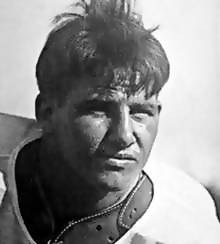
Gerry Dalrymple
Sport: Football
Induction Year: 1964
University: Tulane
Induction Year: 1964
Legendary Notre Dame coach Knute Rockne one summed up Gerry Dalrymple, Tulane University’s first consensus All-American football player.
“You can sit in the stands and see him play,” Rockne said, “or you can close your eyes and hear him play.”
A native of Rosston, Ark., Dalrymple was a 126-pound quarterback at Prescott High. He later worked odd jobs at Ouachita Junior College in Arkadelphia for three years so that he could continue his football career as an end on the Ouachita squad. Then he moved to Hammond, La., working as an oiler on a giant excavating machine. An avid Tulane fan, Dr. Edward McGehee, heard about his football exploits and found him a job at the Railroad Express Agency in New Orleans that paid 60 cents an hour—40 more than he was making on the construction job.
Dalrymple enrolled at Tulane and sat out one year after breaking a leg in spring practice. Then he led Green Wave teams coached by Bernie Bierman to a 28-2 record in three seasons.
Gerald Richard Dalrymple was two-time All-Southern Conference, two-time All-America and team captain in 1931. In 1954, he was inducted into the National Football Foundation Hall of Fame.
“Even in the press box,” wrote Fred Russell of the Nashville Banner, “one is affected by the inspirational qualities of the great Greenies leader.”
Dalrymple set a standard by which other All-American ends in the 1930s would be measured; Paul “Hoss” Geisler of Centenary and Gaynell Tinsley of LSU.
Tulane lost only one regular-season game in Dalrymple’s three seasons—a 14-0 setback at the hands of Northwestern in the second game of his junior season.
The 1931 Wave was 11-0 in regular season play, entering a Rose Bowl berth against one of Howard Jones’ greatest Southern California teams. The Tulane players were star-struck before the game when they were introduced to Hollywood stars Marlene Dietrich and Clark Gable, and saw Douglas Fairbanks and Mary Pickford in a box behind their bench at the Rose Bowl.
When the game got under way, USC took a 21-0 third quarter lead. Then Tulane battle back for a pair of touchdowns before bowing 21-12. With Dalrymple’s fumble recovery setting up one score, the Green Wave dominated the statistics with 310 yards to the Trojans’ 230 and a 16-7 advantage in first downs. But Jones’ team had the edge in the only numbers that mattered.
Defensively, Dalrymple was so good that he gave players behind him a false sense of security.
“I can’t remember a ball carrier getting past the line of scrimmage in an upright position,” recalled Dick Baumbach, who played in the secondary during Dalrymple’s sophomore season and later became Tulane’s Athletic Director. “The first time one did, and this was because we had subs in the game, I was so surprised he ran right by me for 60 yards to a touchdown.”
Dalrymple even made tackles on the other side of the field. With Tulane clinging to a 7-0 lead over Texas A&M in the 1931 season, the Aggies’ Frenchie Domingue broke into the clear on a sweep around left end. Dalrymple chased him down to preserve the Green Wave’s closest regular-season game that season. Texas A&M and LSU (a 12-7 loser to the Green Wave in the 1930 finale) were the only teams that came within a touchdown of Tulane in the 18-game winning streak between the losses to Northwestern and Southern Cal.
The LSU game saved the job of the Tigers’ head coach, Russ Cohen, for one more year. With gamblers offering as many as 25 points and 5-1 odds, LSU took advantage of Dalrymple’s aggressive defensive play early in the game when Dobie Reeves faked a punt and laterled to Billy Butler—who was chased down at the Wave seven yard-line by Hugh Whatley after a 60-yard run. A goal line stand at that point proved to be the difference as Dalrymple caught a touchdown pass against the Tigers for the second year in a row. Roy Wilson scored the only LSU touchdown on a blocked punt.
Russ Cohen had already been “fired” by Huey Long, but the “Kingfish” was so impressed by the Tigers’ courageous effort that he “rehired” Cohen in the dressing room after the game.
A year later, after Don Zimmerman and Dalrymple led Tulane to a 34-7 rout of LSU in Cohen’s final game as the Tigers’ coach, Cohen called the Green Wave “the greatest team I’ve seen any time, any place, anywhere.”
Teammate Harry Glover called Dalrymple “the greatest defensive end I have ever seen.”
“I wouldn’t attribute his success to quick reflexes, but rather to the knack of doping out what was coming next,” Glover said. “He was always thinking.”
A perfect example of his heads-up play came in the 1931 Georgia game, witnessed by what was the Southern record crowd of 40,000 spectators a Georgia’s Sanford Stadium.
With Tulane leading by six points at halftime, Georgia attempted a hideout play with All-American end Vernon “Catfish” Smith crouched on the sideline, blending in with a line of substitutes. Dalrymple spotted Smith, but didn’t have time to alert the Green Wave secondary. So he charged across the line of scrimmage and pounced on the ball before it could be snapped. Tulane was penalized five yards, but Georgia’s chance to catch the defense napping went down the drain and the Wave rolled on to a 20-7 victory.
Dalrymple marred the former Dorothy Benedict in 1932 and they had two sons and one daughter. He earned his master’s degree in physical education from LSU and coached at Southwest Louisiana, Arkansas Teachers College and John Brown University.

Recent posts
-
Louisiana Sports Hall of Fame announces star-studded 2027 induction class September 9, 2026

-
Hall of Famer Jerry Stovall passes away at age 85 August 31, 2026

-
Passing of a legend: LSU’s transformational Skip Bertman dies at 88 August 14, 2026


